Greenhushing – sophisticated greenwashing?
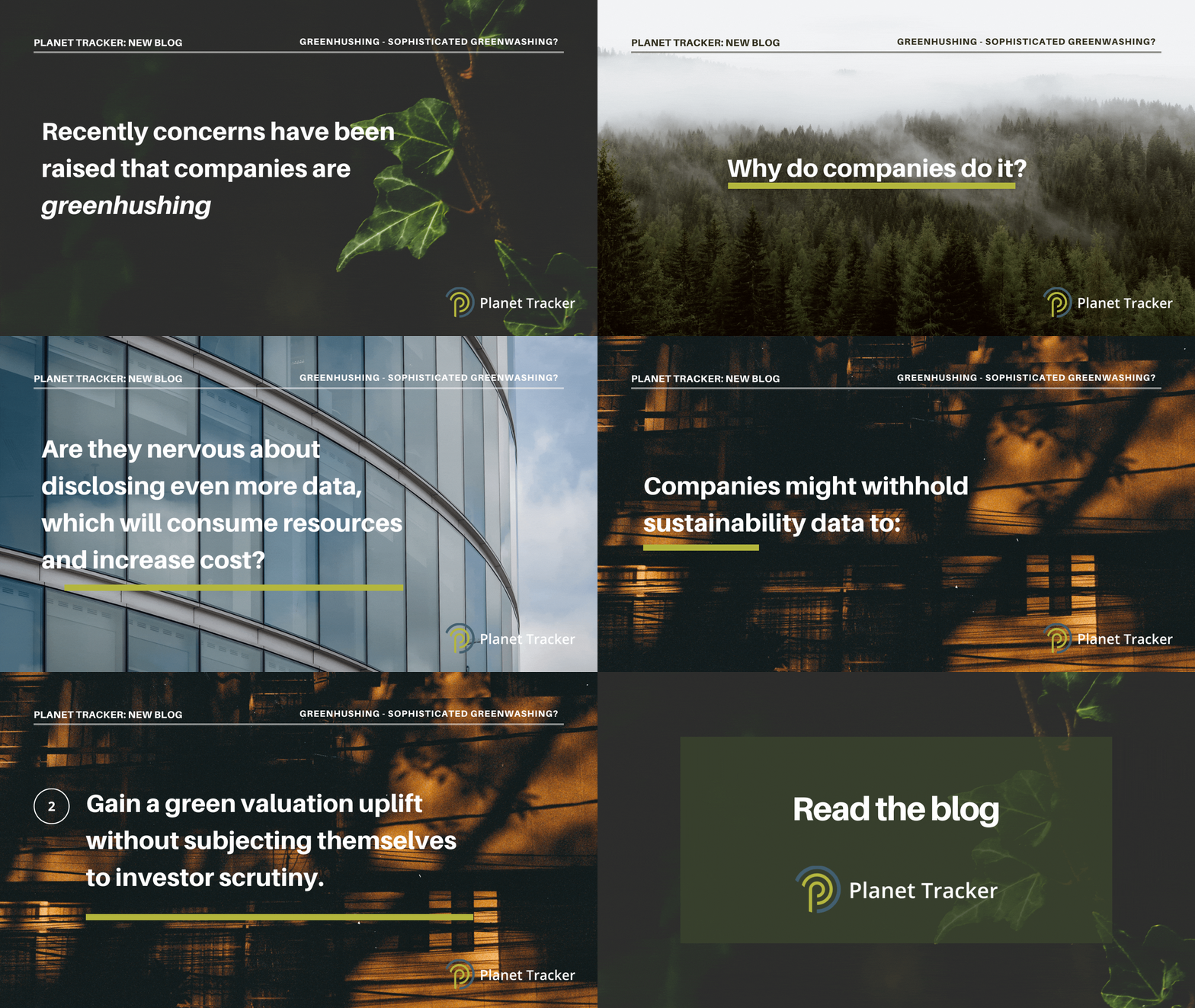
Recently concerns have been raised that corporates are ‘greenhushing’. This occurs when management teams under-report or hide their sustainability credentials. Is this an indication that civil society or investors have gone too far in their demands for sustainability metrics, leaving management teams cautious about declaring their progress on green or sustainability issues? Planet Tracker urges caution; this could be the next step in the evolvement of increasingly sophisticated greenwashing.
Greenhushing claims
Greenhushing can be defined as organisations which deliberately choose to hide their green or ESG credentials from public view. Academics have studied this issue for years. For example, evidence of managers in the hospitality industry choosing not to reveal their corporate social responsibility (CSR) was found while other papers have examined whether direct CSR communication could offend customers or even provoke negative feedback. Some have argued that greenhushing firms are “quietly conscientious” and choose not to make sustainability part of their brand.
Recently, greenhushing was investigated by South Pole, the climate solutions provider, in its report ‘Net Zero and Beyond’. In its analysis, South Pole surveyed over 1,200 global sustainability executives from 12 regions.
The report states, ‘We found a surprising trend: nearly a quarter of these surveyed global climate leaders will not be publicising their achievements and milestones beyond the bare minimum or as required by for example the Science Based Targets initiative’. South Pole expressed concern stating that ‘we need those making headway on sustainability targets to inspire others to make a start, to help shift mindsets and then behaviours’ later adding that it ‘is impossible if progress happens in silence’.
Feeling the need to under report
It would indeed be a shame if sustainability leaders became nervous about sharing their successes and experiences. And to be fair, there could be some genuine reasons to hold back. For example, executives may fear they could be asked for ever increasing amounts of sustainability data which, in turn, consume more resources and increase costs. This is particularly important to smaller companies.
Alternatively, management may view it as good practice to test their green credentials over a longer period and therefore hold back ESG data until they have a more comprehensive time series. Similarly, they may be awaiting external verification of their sustainability metrics. Or it may simply be a derivation of the common management philosophy: ‘under-promise and over-deliver’.
Avoiding any political backlash could also be a genuine reason to keep quiet; this avoids the danger of being caught between pro- or anti-ESG factions. And there are also regulators on the prowl and happy to call-out misleading sustainability or green claims. Learning from the mistakes of other corporates which incur regulatory fines could be a sensible strategy. Finally, a company may sell products for which sustainability is not an important consumer consideration. Ideally, marketing messaging needs to be simple and powerful; adding sustainability credentials may not be in the salesforce’s best interest.
In many of these instances, the investor could reasonably view greenhushing as a positive strategy. For example, if management is unsure of its green credentials, it is wise to hold back in order to avoid a possible mispricing or a harsh regulatory response.
Maybe not so innocent?
However, there are reasons to question whether greenhushing is always so positive. Management teams may be trying to gain a green valuation uplift without subjecting themselves to proper investor scrutiny by allowing investors searching for investment opportunities to assume or decide that the company’s sustainability performance is stronger than its official pronouncements suggest. Investors search for inefficient pricing; greenhushing hints at this – i.e. the company is more sustainable than many believe. Executives may be facing proxy votes or intensive active engagement on sustainability-linked issues. Greenhushing may provide some respite.
Planet Tracker encourages those investors which engage with management teams which they suspect hint at greenhushing, to challenge them to reveal the true situation and correct or corroborate any market perceptions around the company’s sustainability performance.
Why Greenhushing might not be driven by modesty
- Sustainability practice might not be as impressive as claimed. By greenhushing the management team do not need to reveal their sustainability data but may give the impression they are greener by remaining vague .
- Possible market mispricing. Companies which lead on sustainability or sustainable financial instruments can demand a valuation premium – i.e. higher valuation multiples or lower bond yields. If sustainable claims are unjustified investors could suffer from mispricing.
- Regulatory risk is minimised. Globally, both financial and consumer regulators are calling out greenwashing. By holding back on a public statements, management cannot be charged with issuing misleading statements.
- Active engagement becomes easier. With more shareholders asking about ESG progress and sustainable transition strategies, greenhushing implies that progress is underway but based on little more than management reassurance.
A sophisticated greenwash approach?
Planet Tracker is witnessing increasingly sophisticated forms of greenwashing. As regulators and NGOs scrutinise sustainability claims with greater intensity, so corporate giants with sophisticated marketing and skilled communications teams are called into action. Planet Tracker has witnessed greenwashing on a very large scale – see ‘The Alliance to End Plastic Waste: Barely Credible’ – but also at an individual company scale – see ‘Soda-pressing’.
Of course, there is a simple solution to greenhushing. Executives should be transparent about their sustainability successes and failures rather than trying to massage the perceptions of the market. Eventually regulators, such as accounting bodies, may make ESG disclosures compulsory, finally closing down the greenhushing option.