Volatile Markets Require Transparent Analysis of Natural Capital Risks
As of Thursday 26 March, and before the $2 trillion U.S. stimulus package and U.S. Fed moves come into force, the last time the S&P 500 and the Dow Jones Industrial Average showed similar volatility – chaotic up and down movements – as it has over the past month was in September 1929, when markets collapsed at the start of the Great Depression.
Called the fear index or fear gauge, the Chicago Board Options Exchange’s CBOE Volatility Index – the VIX, a globally used tool describing market volatility based on S&P 500 index options, has spiked to levels last seen in the market crash of 2008-09.[i] And now, governments and monetary authorities are daily rapidly changing fiscal and monetary policy agendas to address extreme market price gyrations.
Yet as markets are adjusting to supply chain disruptions created by simultaneous supply and demand shocks, should you try to assess natural capital risks to protect your portfolio or should you try to protect your portfolio from natural capital risks?
No matter what form the recovery takes, people are still going to rely upon natural capital for their daily sustenance and livelihoods.
Agriculture is a $5 trillion global industry with hundreds of different commodities transacted on exchanges. With thousands of different contract types – from turmeric to timber, from barley to bananas and from beef to biofuels – supply chain transparency is a critical business advantage, particularly in times of supply and demand shocks, whether short-term or long-term.
Natural capital underpins this $5 trillion industry which in turn underpins economic value across many sectors and many companies. As companies are unfortunately currently realizing in real time, they face challenges when the agriculture commodities, which are fundamental to the food and agriculture systems, they rely on face short-term supply and demand shocks.
- Live cattle April 2020 futures, a key measure of protein security and global trade in the U.S., are gyrating wildly.[ii] Across the world, in India, meat exports are down 12% and rice forwards have fallen.[iii]
- Palm oil imports into China in February 2020 were down 4% – or 300,000 tons – to 6.9 million tons as a result of coronavirus impacting demand as palm oil is a key ingredient used in noodle dishes.[iv]
- Milk March 2020 futures have seen their prices have rapidly decreased based on decreasing export demand as uncertainty in agriculture supply chains increases.[v]
- The NASDAQ Salmon Index that measures weekly reported sales for farmed salmon in the Nordic countries has similarly bounced around. Now, flight bans are decreasing global exports of fresh fish.
- Even U.S. homebuilders are being hit by supply and demand risks as their ability to source lumber is constrained just as markets for new houses[vi] are drying up despite 30-year mortgages being at record lows.[vii]
Nations are also changing policies:
- China’s planned purchase of $80 billion in U.S. agriculture products is now in doubt, putting downward pressure on U.S. exports.
- Australia’s National Bushfire Recovery Agency stated that a portion of the funds for recovery from Australia’s fires now will be budgeted instead for the coronavirus response.
- Central banks are trying to play catch up and adjust monetary policies on the fly, with the U.S. Federal Reserve Bank, for example, trying to boost demand by increasing short-term fixed income purchases – its repo purchases – while the U.S. government has passed a $2 trillion stimulus package this week too.
- Central banks are also quickly deregulating risk mitigation frameworks, put in place post 2007-08 to improve financial institutions’ capital adequacy, leverage and stress testing criteria, which may, over the mid-term, increase systemic risk.
- Meanwhile, agriculture traders are being hurt as global financial institutions make a dash for cash pushing USD prices and causing agriculture commodity price dislocation.
And more broadly, as more people are working at home and social distancing, we can learn from the Italian and Chinese experiences.
- In Italy, power use decreased after the government shut down the economy, yet this is creating higher residential power demand.
- Morningstar reported that China’s carbon emissions decreased 25% since their quarantines were enacted.
Overall grid operators are less worried about the virus hitting their control rooms than adjusting to residential power demand spikes.
At the same time, the clean energy and oil gas sectors are also impacted.
- With global public finance focused on increasing credit and improving liquidity, clean energy investment may be undermined.
- Cheap gas may push some energy names into bankruptcy.
But, as shown in Figure 1, companies also face long-term supply and demand shocks too. The non-profit FAIRR (Farm Animal Investment Risk and Return) Initiative recently released a tool that forecasts lost profits of 30% to the leading beef companies globally – JBS, Tyson Foods, BRF, Maple Leaf Foods and Minerva – given a 2° Celsius increase in temperatures by 2050.[viii]
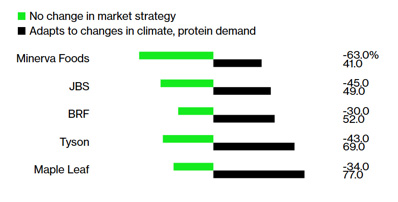
Figure 1: FAIRR Climate Risk Tool, Impact of 2°C Temperature Increases on EBITDA. Source: Bloomberg.[ix]
Natural capital is the foundation of sovereign health and natural capital underpins the solvency of many companies and sectors throughout the economy.
Given the inflection point they are now facing, markets need resilient tools that include transparent analysis of natural capital risks.
Policymakers need to be careful that in their efforts to solve one problem, they do not make other problems more acute. They need to focus on integrating their efforts with green stimulus packages.
Putting people back to work should focus on work in a healthier and greener environment.
Our communities’ health can only recover when our communities also have access to cleaner water, cleaner air, cleaner food and cleaner energy.
[i] http://www.cboe.com/vix/
[ii] https://www.cmegroup.com/trading/agricultural/livestock/live-cattle.html
[iii] https://economictimes.indiatimes.com/news/economy/indicators/coronavirus-meat-rice-pharma-exporters-worried/articleshow/74583623.cms
[iv] USDA (12 March 2020). Oil crops outlook.
[v] USDA.
[vi] https://www.bloomberg.com/news/articles/2020-03-12/bofa-cuts-homebuilders-bracing-for-inevitable-virus-hit
[vii] https://www.marketwatch.com/story/mortgage-rates-hit-all-time-low-amid-coronavirus-concerns-freddie-mac-2020-03-05?mod=article_inline
[viii] https://www.bloomberg.com/news/articles/2020-03-12/climate-change-could-wipe-billions-from-long-term-meat-profits
[ix] https://www.bloomberg.com/news/articles/2020-03-12/climate-change-could-wipe-billions-from-long-term-meat-profits