Top AgriFunds are generally not reporting key nature-related risks to investors, says Planet Tracker

Financial think tank’s latest report urges investors in the US$3.34 trillion agriculture sector to use industry guidelines to align their capital with sustainable food and agriculture systems.
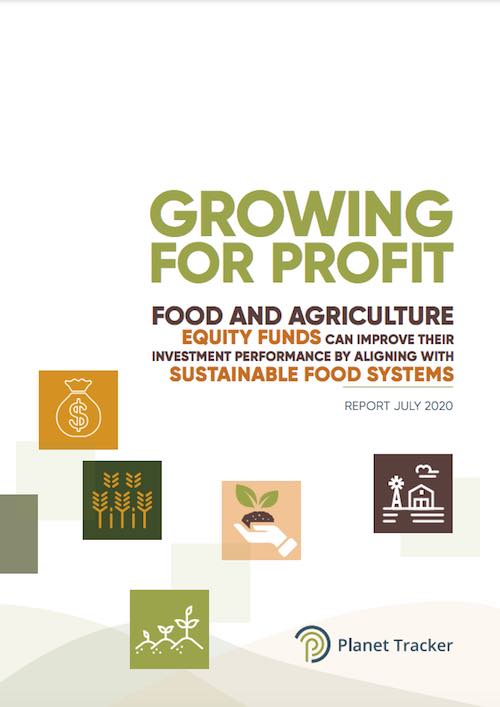
London, 01 July 2020: Despite the increasingly material impact that ecological risks are having on the performance of food and agriculture listed equity investments, a report published today by financial think tank Planet Tracker has found a distinct lack of disclosure of such risks by key listed equity funds investing in the food and agriculture sector (AgriFunds) – including major institutions such as Bank of America, Goldman Sachs, Morgan Stanley, UBS, State Street, Royal Bank of Canada and Credit Suisse.
Growing natural capital risks (that is, risks to the world’s stocks of natural resources) are increasingly causing local economic disruption which can lead to significant economic risks including budget shortfalls, revenue losses, and potential credit downgrades and expose major investors in the food and agriculture sector to material risk. Yet in a review of a sample of 37 AgriFunds with an aggregated market value of US$21 billion at the end of 2019, Planet Tracker discovered that only 8% reference one or more of the natural capital risks which have a direct material impact on food and agriculture production, such as climate change, land degradation and biodiversity loss. What’s more, only a single fund communicates a commitment to one or more sustainability initiatives and industry guidelines for sustainable investing in the sector in its 2018/19 annual report and related securities’ filings.
This, says Planet Tracker, leaves the top 20 AgriFund investors – who account for approximately 30% of the total assets under management invested by the 37 AgriFunds – materially exposed to natural capital-related financial risks that are not being sufficiently disclosed, thus representing both a transparency risk and reporting failure.
Furthermore, Planet Tracker found that not only have the 37 AgriFunds tended on aggregate to underperform the S&P Global 1200, but also that the more closely exposed they are to upstream food and agriculture production companies, the greater the underperformance. In fact, from 2010 to 2019, the 37 AgriFunds have on aggregate underperformed the S&P Global 1200 by 17%.
The report calls for Agrifund managers, analysts and investors to measure, manage and monitor the natural capital risks of Agrifunds by aligning their management with industry guidelines for sustainable investing in the sector in order to mitigate environmental supply side production risks.
The report calls for public reporting and the adoption on the following recommendations by 2022:
- Commit to investing in solutions and think beyond the spreadsheet as natural capital risks often do not appear in traditional and dated financial tools.
- Report responsible investor alignment in annual reviews with at least one of the PRI Responsible Investment in Farmland, the CFS Principles for Responsible Investment in Agriculture and Food Systems and the OECD-FAO Guidance for Responsible Agricultural Supply Chains or equivalent principles.
- Measure, manage and monitor natural capital risk exposure for investments and on an aggregated portfolio basis within pre-defined time-bound natural capital risks that can impact an investment’s earnings.
- Align Investments with Food and Agriculture Systems Sustainability: AgriFunds need to align their investments with food and agriculture systems’ sustainability including advances in farming technologies, regenerative agriculture, alternative meat proteins, supply chain efficiencies and evolving consumer demand.
- State publicly that portfolio managers are actively seeking out and screening investments for opportunities to invest in sustainable food and agriculture systems, as food and agriculture sector companies are embracing these business opportunities by aligning reduction in impact with product branding.
- Update their investment processes for existing funds or to launch new investment funds targeting sustainability opportunities in the food and agriculture sectors aligned with global policy mandates.
- Benchmark their investments against indices aligned with the transition to a sustainable food system.
- Adopt regenerative agriculture as a framework for assessing their investments as regenerative agriculture describes the pathway towards food and agriculture systems’ sustainability.
You can read the full report here.
The report builds on Planet Tracker’s research into AgriFunds, following its recently-launched AgriFunds Data Dashboard, which provides dynamic and regularly updated information to the financial community on the nature and impact of market practices and funds.
– END –
Notes for editors
About Planet Tracker
Planet Tracker is a non-profit financial think tank aligning capital markets with planetary limits. It was created to investigate the risk of market failure related to ecological limits. This investigation is primarily for the investor community where ecological limits, other than climate change, are poorly understood, even more poorly communicated and not aligned with investor capital. Planet Tracker generates breakthrough analytics to redefine how financial and environmental data interact with the aim of changing the practices of financial decision makers to help avoid environmental collapse.
Media contact
Ronak Anand
Moorgate Communications, a Finn Partners company
ronak.anand@finnpartners.com / +44 20 7539 3578