
Japan’s Revised Fisheries Act makes Transparency the Key to Future Competitiveness for $134 Billion Private Fisheries Sector
Ocean, Policy

Transparency was the key discussion point at last week’s Sustainable Seafood Symposium hosted by Seafood Legacy in Tokyo with more than 1,000 attendees, where Planet Tracker spoke on two panels.

In revising its Fisheries Act in 2018 for the first time since 1949, the Government of Japan introduced scientific baselines for most commercial fishing species while opening doors for private sector investment enabled by a $2 billion increase in public spending to support this transition towards scientific management of domestic fisheries.

The Japanese domestic wild-catch seafood industry is now required to comply with the Act by transparently reporting where it fishes, what it fishes and how those fisheries are sustainably managed. The Act now states “ensure sustainable use of marine resources”.

With 41 publicly traded companies worth $134 billion in the fisheries sector in Japan, the Japanese seafood industry is the 6th largest source of international trade for Japan, right behind electronics. Overall, the Japanese seafood industry accounts for 2% of Japan’s exports and imports respectively, making the seafood industry critical to supporting the country’s GDP growth, macroeconomic stability and sovereign health.

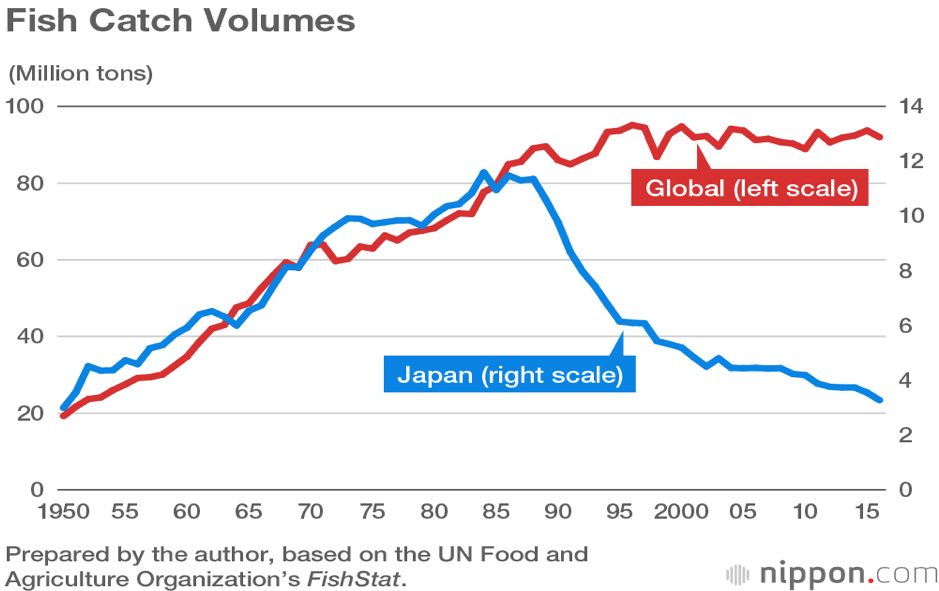
For example, as shown below, Japan’s wild-catch fish volumes have declined 74% from 12.8 million tonnes in 1985 to 3.3 million tonnes in 2017.
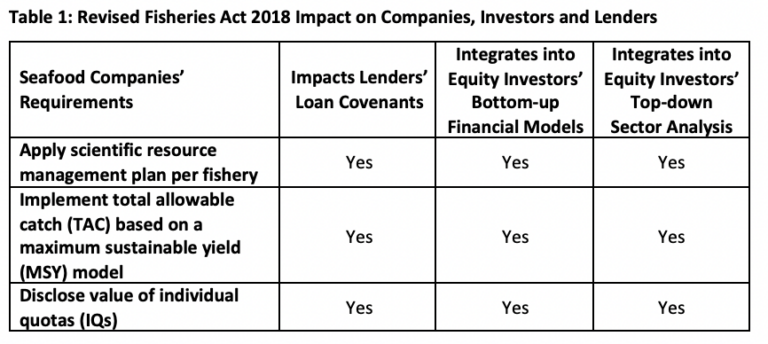
The Fisheries Act enables investors and lenders, with their $134 billion investment in the industry, to ask for seafood sourcing information such as cash flow from operations, sources of revenue and costs of goods sold from the 41 companies they finance. As shown below, compliance with the Act means that, if companies have direct or indirect ownership exposure, they need to disclose the scientific baselines for the fisheries they work, their total allowable catch based on a maximum sustainable yield model and their individual tradeable quotas.

This transparency is key for lenders in the sector as it informs loan covenants. It also helps asset owners and asset managers choose how to invest in the sector, whether through integrating this financial information into models, or informing positive or negative screening of the 41 companies in the sector.
The revised Act is good for Japanese business and its critical contribution to the Japanese economy. As Japanese investors scale back their investments in coal and address investments in palm oil, they are also beginning to assess their exposure to declining seafood stocks and their responsibility to invest in companies that manage their operations by applying scientific principles.

Given this, the Act enables transparency making it easier for investors to align their capital with companies who are managing their resources responsibly. This transparency will support the reversal of decades of declining domestic fish stocks by applying scientific principles to most commercial fisheries. Finally, financial transparency is key for the Japanese seafood industry to remain competitive and maintain its role as a global leader in industry.

Related Content

The latest reports to your inbox

Don’t miss out! To receive Planet Tracker's reports just click below and complete the contact form.
 

Sign up

Privacy Overview

Our Sites use cookies to enhance your experience while using those Sites. Cookies are pieces of information that some websites transfer to the computer or device that is browsing that website and are used for record-keeping purposes at many websites.

Our Sites may place and access certain first-party cookies on your computer or device. First-party cookies are those placed directly by us and are used only by us. We use cookies to facilitate and improve your experience of our Sites and to provide and improve our services. We have carefully chosen these cookies and have taken steps to ensure that your privacy and personal data is protected and respected at all times.

All cookies used by and on our Sites are used in accordance with current data protection and privacy law.

Before cookies are placed on your computer or device, you will be shown a prompt requesting your consent to set those cookies when you access one of our Sites. By giving your consent to the placing of cookies you are enabling us to provide the best possible experience and service to you. You may, if you wish, deny consent to the placing of all cookies, but you will not be allowed access to the site.

Certain features of our Sites depend on cookies to function. These cookies are sometimes known as “strictly necessary” cookies.

Our Sites also use analytics services provided by Google. “Google analytics” refers to a set of Google tools used to collect and analyse anonymous usage information, enabling us to better understand how the relevant Site is used. This, in turn, enables us to improve our Sites and the services offered through them.

The analytics service used by our Sites uses cookies to gather the required information. Our use of these analytics does not pose any risk to your privacy or your safe use of the relevant Site, however it does enable us to continually improve that Site, making it a better and more useful experience for you.

The analytics service used by our Sites uses the following cookies:

Name of Cookie First / Third Party Provider Purpose
Google Analytics Third Google For analysing use

In addition to the controls that we provide, you can choose to enable or disable cookies in your internet browser. Most internet browsers also enable you to choose whether you wish to disable all cookies or only third-party cookies. By default, most internet browsers accept cookies, but this can be changed. For further details, please consult the help menu in your internet browser or the documentation that came with your device.

You can choose to delete cookies on your computer or device at any time, however you may lose any information that enables you to access the relevant Site more quickly and efficiently including, but not limited to, login and personalisation settings.

It is recommended that you keep your internet browser and operating system up-to-date and that you consult the help and guidance provided by the developer of your internet browser and manufacturer of your computer or device if you are unsure about adjusting your privacy settings.

Social sharing links

We also use Google Analytics to track social shares made at our website. Google automatically collect and store certain information in their server logs which includes device event information such as crashes, system activity, hardware settings, browser type, browser language, the date and time of your request and referral URL, cookies that may uniquely identify your browser or your Google Account, in accordance with their data privacy policy: https://policies.google.com/privacy

Twitter:

We use a Twitter Tweet widget at our website. As a result, our website makes requests to Twitter’s servers for you to be able to tweet our webpages using your Twitter account. These requests make your IP address visible to Twitter, who may use it in accordance with their data privacy policy: https://twitter.com/en/privacy#update

LinkedIn:

We use a Linkedin Share widget at our website to allow you to share our webpages on Linkedin. These requests may track your IP address in accordance with their data privacy policy: https://www.linkedin.com/legal/privacy-policy