Investors face financial risk as salmon industry approaches ecological brink, says Planet Tracker
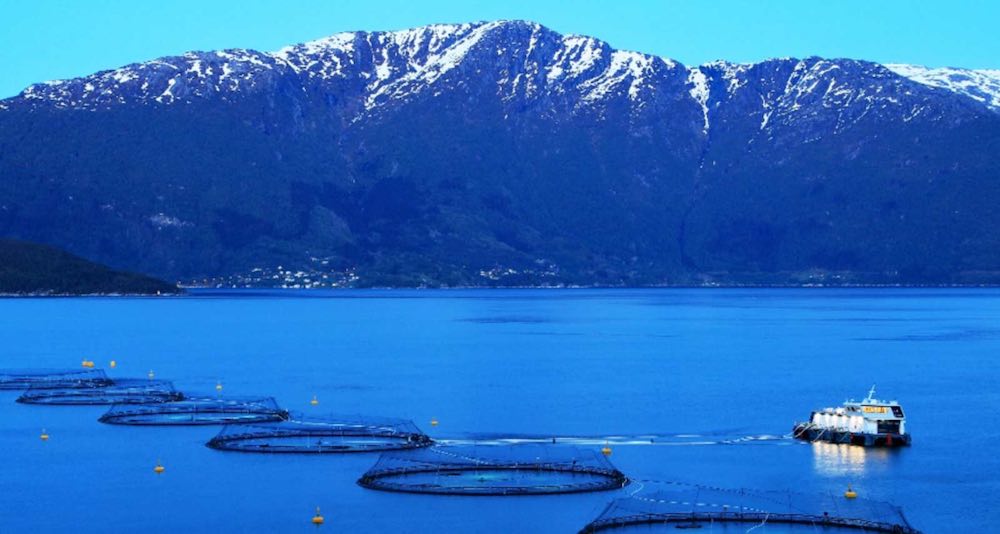
Substantial investment in sustainable farming technology needed to mitigate environmental risks faced by US$18 billion farmed Atlantic salmon industry.
London, 27 May 2020. Salmon production is fast approaching the practical physical limits permitted by current coastal farming methods, according to a report published today by non-profit financial think tank Planet Tracker. Despite this, says the report, the industry is still some way from moving to more sustainable and cost-effective methods at scale.
While positive mid-term demand and higher prices may give the impression of a stable and profitable sector, both large- and small-scale producers in the farmed salmon sector face significant environmental threats such as climate change, disease, sea lice and harmful algal blooms. Compounded by issues such as collapsing wild-catch feedstock fisheries, the industry and its investors face considerable financial risk of increased environmental constraint-based losses and price volatility.
Such price volatility is already apparent due to the COVID-19 pandemic, which has reduced demand for farmed Atlantic salmon (the second most commercially valuable farmed aquatic species and accounting for over 92% of total farmed salmon) and resulted in a 14% decline in spot prices in Q1 2020. Depending on post-COVID-19 recovery time, markets could see oversupply over the next 12 to 24 months, exacerbating suppressed prices.
Planet Tracker estimates that if historic trends continue and coastal ecological health continues declining, total production forecasts for coastal farmed Atlantic salmon to 2025 may be 6% to 8% lower than predicted, equivalent to US$4.1 billion. This is particularly significant for the industry’s highly-concentrated investor pool, with the top 20 – including Vanguard, DNB Asset Management and the Canada Pension Plan Investment Board – accounting for over US$15 billion in holdings. Salmon production itself is also highly concentrated, with nearly 50% in Norway, the UK, Chile and Canada carried out by just ten publicly-traded companies with a total market capitalisation of US$28 billion.
If it is to continue to increase production supply and manage its environmental exposure, the industry will eventually need to expand beyond intensive coastal farms, either to off-shore closed caged systems (CCS) where the biological constraints are reduced; or to high-tech inland recirculating aquaculture systems (RAS) which are still in the experimental stage. Either option will entail substantial investment and likely to cause salmon prices per kilogram to increase through to 2030.
Though subject to market price pressures and early stage development challenges particularly in scaling the technology, investors should weigh the higher capital and operating expenditure and risks of offshore and inland farming against the environmental risk mitigation benefits that these new technologies can bring in reducing production losses.
As such, Planet Tracker recommends that farmed salmon companies should by the end of 2020:
- Report on compliance with environmental regulations and industry guidelines to highlight their environmental commitments to investors making them more attractive for investment.
- Maintain and report on an effective Environmental and Social Management System (ESMS). such as the CDC ESMS Toolkit. Such frameworks should be auditable and published and provide 100% citing of reasons for salmon losses.
- Deploy remote electronic monitoring systems with live data feeds accessible by investors and covering core environmental metrics such as water temperature and effluent control.
- Increase research and development spending on environmental risk mitigation such as disease and sea lice control measures.
- Strengthen control of third-party independent audited transparency and traceability reporting for all feed sources.
And by 2021, investors can help manage their exposure by:
- Requiring companies to present and publish effective ESMS to support analysis of companies’ valuation, financial performance and risk exposure.
- Pushing for assessments detailing chemical and antibiotic inputs into waterways and their origins to mitigate the incidence rates of harmful algal blooms and other problems.
- Advocating for marine spatial planning to maximise sustainable farmed salmon production and mitigate environmental risks.
- Applying consistent methodologies, accounting standards (such as IAS 41) and reporting descriptions for both materialised environment-related losses and stocking values.
- Providing an updated log of all salmon losses and account for the related financial costs, monitor environmental constraint losses and follow revised maximum allowable biomass thresholds for 2020 post COVID-19.
About Planet Tracker
Planet Tracker is a non-profit financial think tank aligning capital markets with planetary limits. It was created to investigate the risk of market failure related to ecological limits. This investigation is primarily for the investor community where ecological limits, other than climate change, are poorly understood, even more poorly communicated and not aligned with investor capital. Planet Tracker generates breakthrough analytics to redefine how financial and environmental data interact with the aim of changing the practices of financial decision makers to help avoid environmental collapse.
Media contact
Ronak Anand
Moorgate Communications, a Finn Partners company
ronak.anand@finnpartners.com / +44 20 7539 3578