EUR 678 billion of investor capital at risk from EU plastic industry’s business-as-usual model
To continue competing at global level, companies and investors must commit to rapid transition towards sustainability, urges Planet Tracker
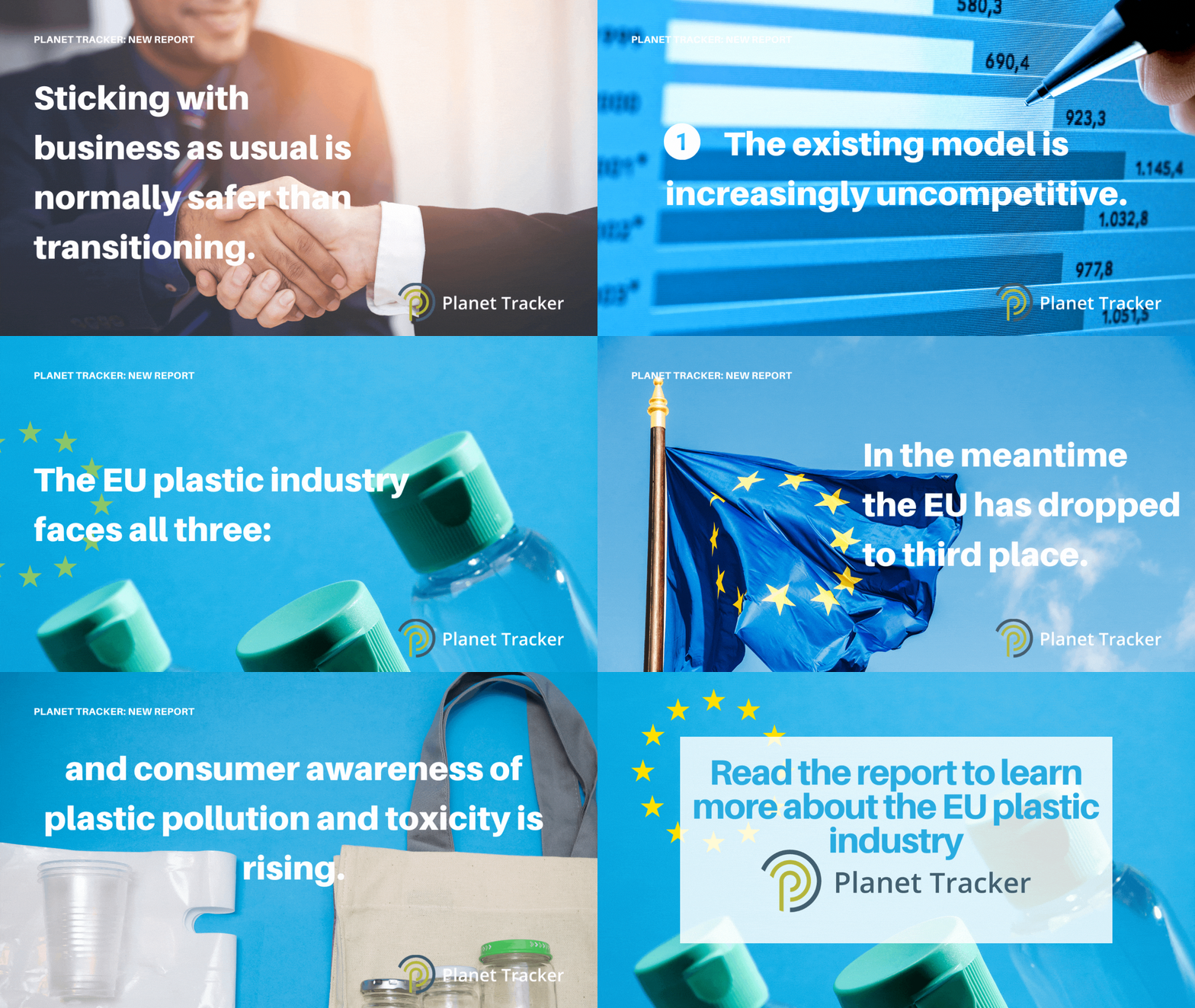
LONDON, 30 May 2022: The EU plastic industry plays an important role in determining the fate of our climate, health and economy. According to Planet Tracker’s latest report, Breaking the Mould, investors, regulators and politicians must ask themselves a crucial question: has the plastic industry’s business-as-usual model become more risky than embarking on a transition towards a sustainability-driven strategy?
The European plastic industry provides an essential source of jobs to the EU27 and for years has been a steady driver of this economy. However, the industry’s rapidly declining ability to compete globally suggests that the industry is primed for disruption and a transition towards a more sustainable business model is now the most viable route to avoid stranding investor assets.
Just 40 banks, brokers, insurers and investment managers provide financial backing to a group of 87 publicly traded companies that account for 75 per cent of plastic production across the EU supply chain – amounting to EUR 678 billion (USD 710 billion) worth of shares – suggesting that decision-making is theoretically well-concentrated. However, analysis reveals that in the last five years, only nine resolutions to introduce new policies have been raised at AGMs, reflecting the current level of ambivalence towards the issue.
Moreover, Planet Tracker’s analysis of 990 corporate bonds and loans issued by the world-leading plastics manufacturers revealed that only three are linked to decreasing plastic pollution. A new strategy is needed to catalyse action.
John Willis, Director of Research at Planet Tracker, comments: “The EU plastic industry is on the precipice. Its current model is increasingly unsustainable. It is struggling to compete globally. With the threat of new regulatory changes increasing, and consumers beginning to understand the impact of plastic pollution on human health, the current model appears a high-risk option for investors”.
The economic turnover of the EU27’s plastic sector has already flatlined, with zero growth recorded from 2010 to 2019, despite an uptick in global plastics production. In fact, over the course of this decade, the EU27 global chemical market share, and plastics as a percentage of EU27 chemical sales, both declined. Meanwhile, China grew its global chemical sales from EUR 609.5 billion to EUR 1,488.0 billion (USD 639 billion/1,559 billion) and expanded its global market share from 25.8 per cent to 40.6 per cent, making it the leading chemical producer globally by some margin.
The Trilateral Chemical Region (spanning North Rhine Westphalia (DE), Flanders (BE) and the Netherlands) may provide the answer to Europe’s problem. The combined economic turnover of the region is EUR 180 billion (USD 189 billion) and the chemical industry and plastics sectors employ more than 350,000 people. According to a joint declaration of intent, the region is currently working to expand its pipeline network in the hope of elevating the region’s competitive edge. But unfortunately, there is still no effective sustainable strategy, putting the countries in the region at significant sovereign risk.
For the EU’s plastic industry to remain competitive at a global level, the 87 plastics companies tracked in this paper must develop and publish their business transition strategies to move towards fully sustainable plastic production by 2025. Without the input of these industry leaders, meaningful progress is implausible, and the European market will suffer as a result.
The report calls on plastics companies to:
- Determine whether the present business-as-usual strategy is financially sustainable or whether a realignment to a more circular business model based on a reuse, recycle and reduce model has become a lower risk, and longer term more profitable, option.
Equity investors, debtholders and financiers should:
- Probe executives on how they assess the impact of current headwinds (e.g falling cost competiveness, increasing regulation etc.) and their plan to maintain or increase returns against this backdrop.
Policymakers and regulators should:
- Push the plastic industry to change its present business model from being a major emitter of carbon dioxide, a significant source of toxins, the origination of plastic pollution and a negative influence on human health.
– ENDS –
ABOUT PLANET TRACKER
Planet Tracker is an award-winning non-profit financial think tank aligning capital markets with planetary boundaries. Created with the vision of a financial system that is fully aligned with a net zero, resilient, nature positive and just economy well before 2050, Planet Tracker generates breakthrough analytics that reveal both the role of capital markets in the degradation of our ecosystem and show the opportunities of transitioning to a zero-carbon, nature positive economy.
ABOUT PLASTICS TRACKER
The goal of our Plastics Programme is to stem the flow of environmentally damaging plastics and related products that are creating global waste and health issues by transparently mapping capital flows and influence in the sector starting from resins production through to product use. By developing transparent financial modelling and forecasting tools, promoting circular economy principles and end of life solutions and identifying financial and profitability risks of continuing business as usual practices in the midstream and upstream of the supply chain, Plastics Tracker seeks to constrain production of environmentally damaging plastics which are feeding the plastics waste problem while supporting development of sustainable solutions.
Media contact
Ophelia Jeffrey
Aspectus Group
ophelia.jeffrey@aspectusgroup.com
+44 (0) 7584 657 646