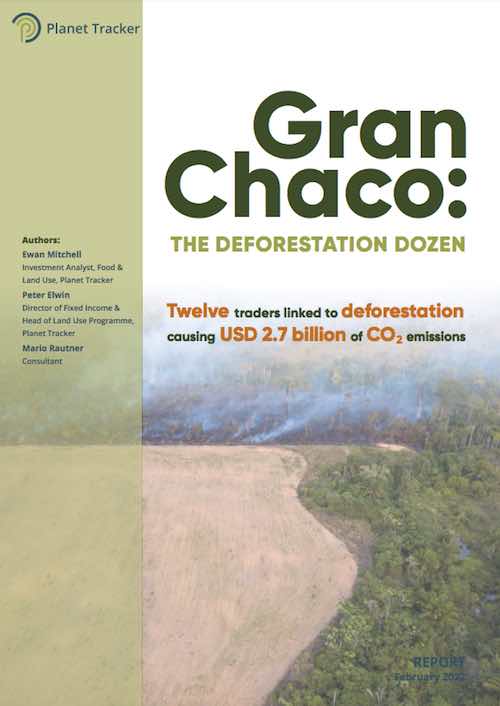
Deforestation Dozen: twelve traders linked to deforestation causing USD 2.7 billion of CO2 emissions, Planet Tracker reveals
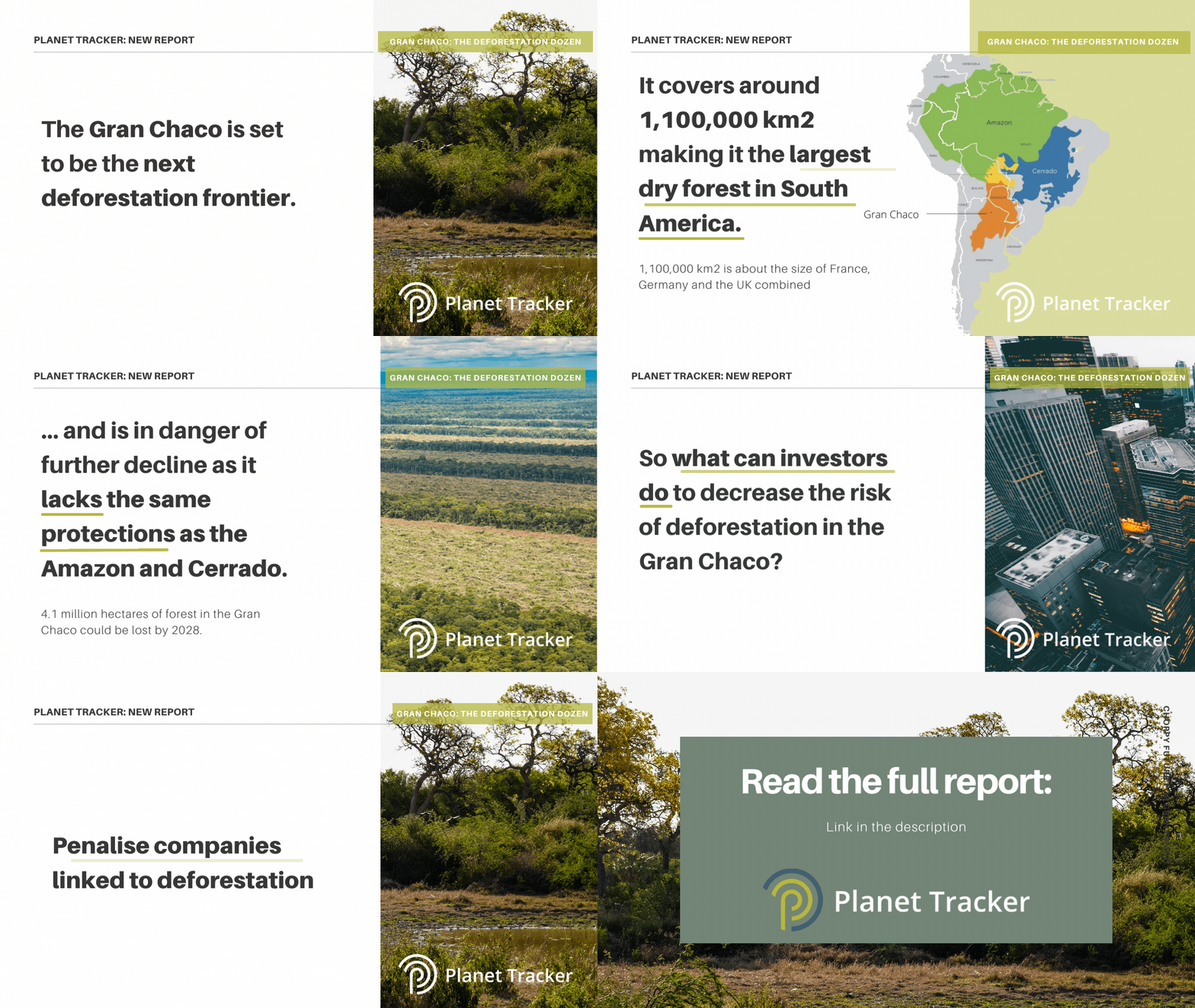
12 soy traders control 89% of soy exports in Gran Chaco – but failure to control deforestation is causing avoidable CO2 emissions worth up to USD 2.7 billion
LONDON, 2 March 2022: The Gran Chaco is fast becoming the next major frontier of deforestation, due to the rising global demand for soy, cautions Planet Tracker’s latest research.
The Gran Chaco is the largest dry forest in South America, around a quarter of the size of the entire European Union. Despite the region suffering a devastating rate of deforestation, equivalent to 20% loss of native vegetation in 15 years, it is receiving limited attention from corporate actors and investors in comparison with activity in the Cerrado and Amazon.
The risk of deforestation has been significantly increased by inadequate legal protection, a lack of funding for enforcement, and insufficient progress in removing deforestation risk from the soy supply chain by the traders, food manufacturers and food retailers involved.
The report calls out the ‘Deforestation Dozen’: 12 soy traders that control 89% of soy exports from the Paraguayan and Argentinian Gran Chaco, who are failing to prevent soy-driven deforestation in the region. The current level of deforestation is creating significant risk for these traders and other companies in the supply chain due to the associated CO2 emissions.
According to Planet Tracker’s findings, the price of soy from the Gran Chaco would more than triple if embedded deforestation CO2 emissions were priced in at USD 91/tonne (the current EU Emissions Trading System price). A review of the policies of the 20 largest equity investors funding the ‘Deforestation Dozen’ revealed that only one of them explicitly recognises the Gran Chaco as a high-risk biome – and not one of them has a forest investment policy that includes the Gran Chaco.
This means that companies seeking funding will not face the same checks regarding deforestation in the Gran Chaco as they do in other biomes.
Financial institutions must work closely with companies to ensure the rapid adaptation and implementation of policies and commitments to prevent deforestation in the Gran Chaco and the devastating economic impact this would have on the planet – as well as on investors.
The report calls on investors to implement the following:
- Actively engage with and support initiatives such IFACC, to move funding away from deforestation linked activities in the Gran Chaco.
- Make the financing of companies operating in the Gran Chaco contingent on comprehensive zero deforestation policies that include time-bound requirements for monitoring and transparency.
- Require trading companies to disclose the location of the soy silos and source farms in their supply chains to aid traceability as a condition of funding.
- Require portfolio companies to purchase only RTRS-certified soy.
The report calls on financial institutions to adopt the following policies:
- Publicly commit to ensuring zero deforestation risk in their investment/lending portfolios.
- Reinforce the commitment by publishing regular, timely action plans and progress updates.
- Require portfolio companies to proactively report on deforestation-linked CO2 emissions in their supply chains.
- Specifically target deforestation-linked emissions in their ‘net zero’ plans.
The Deforestation Dozen:
Aceitera General Deheza
Archer Daniels Midland
Asociacion De Cooperativas Argentinas
Bunge
Cargill
COFCO Corporation
Compania Paraguaya De Granos
Glencore/Viterra
Louis Dreyfus
Molinos Agro/Perez Companc
Sodrugestvo Group
Vicentin
READ REPORT HERE
– ENDS –
Media contact
Ellie Hyman
Aspectus Group
ellie.hyman@aspectusgroup.com
+44 (0) 7890 072 773
ABOUT PLANET TRACKER
Planet Tracker is an award-winning non-profit financial think tank aligning capital markets with planetary boundaries. Created with the vision of a financial system that is fully aligned with a net zero, resilient, nature positive and just economy well before 2050, Planet Tracker generates breakthrough analytics that reveal both the role of capital markets in the degradation of our ecosystem and show the opportunities of transitioning to a zero-carbon, nature positive economy.
ABOUT FOOD & LAND USE PROGRAMME
Our Food & Land Use programme examines the relationship between food and agriculture companies, environmental risks and financial return, thereby exploring the materiality of embedded nature.
Planet Tracker analyses the macroeconomic mechanisms through which natural capital can affect the ability of a country to pay its sovereign debt and examines the exposure of funds to sustainability shocks, notably through the transition to sustainable production, regional agricultural declines, or novel global policy affecting the trade of nature-dependent goods. Our aim is to align capital markets with the sustainable management of agriculture resources.