Deep sea mining could be worse for the climate than land ores

Deep Sea Mining, Greenwashing

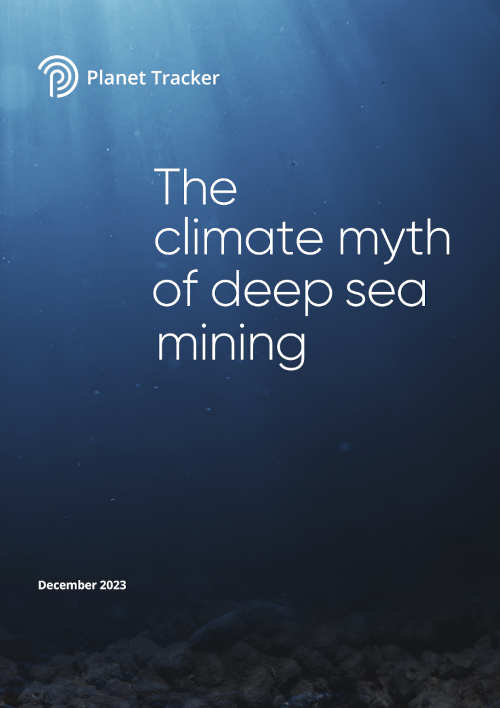
London 5 December: As decisions over the future viability of deep sea mining are under review, Planet Tracker’s latest report ‘The Climate Myth of Deep Sea Mining’ examines deep sea mining companies’ claim that mining polymetallic nodules could be a low carbon alternative to mining on land.

There are only three academic lifecycle assessment studies evaluating the ‘nodule-to-commodity’ climate impact of copper, cobalt, nickel and ferromanganese produced from polymetallic nodules and land ores.

Two of the three studies were funded by, and conducted in collaboration with, deep sea mining companies: one by The Metals Company (formerly DeepGreen Metals) and one by Global Sea Mineral Resources. The third paper, published by Fritz et al. in 2023, had no support from the deep sea mining industry.

Comparing these three studies underlines the huge variance in the estimated climate impacts of nodules and land ores. Depending on the choice of methodology, background data, software and assumptions and parameters used, deep sea nodules could have 28% higher or 76% lower climate impact than land ores. Planet Tracker believes that such a marked variation in results is not a good enough basis for making decisions about the future of deep sea mining.

Over 70% of greenhouse gas emissions for both land ores and deep sea nodules come from metallurgical processing, the energy- and fossil fuel-intensive processes that turn nodules and land ores into metal products. This means that climate impact is less dependent on whether metals come from the deep sea or from land and is more dependent on the properties of processing: mainly the sources of fuel and electricity used, process efficiency and processing technique.

Deep sea mining could have a long-term impact on ocean carbon stocks and sequestration services. Marine sediments are an important part of the global carbon cycle and make up the largest pool of sediment or soil carbon stocks in the world. While the rate of carbon sequestration is relatively slow at the deep seabed, ocean sediments can store carbon for millions of years if left undisturbed.

Planet Tracker estimates that deep sea mining vehicles kicking up sediment plumes could disturb 172.5 tonnes of carbon each year for every km2 mined. For context, only 13.9 kg of carbon per km2 is sequestered every year in the Clarion-Clipperton Zone where deep sea mining licenses have been granted.

Sediment plumes from deep sea mining machinery could impact carbon sequestration taking place in ocean waters by blocking sunlight and reducing photosynthesis. Carbon sequestration carried out by plants living on the nodules being mined would also be stopped completely. These impacts haven’t yet been calculated but considering that nodules take tens of millions of years to form, some of this damage would essentially be permanent.

“Through this research we really want to stress that deep sea mining could be a significant greenhouse gas emissions and contribute to climate change, which exposes financial institutions to policy, regulatory and reputational risks”, says Emma Amadi, Investment Analyst at Planet Tracker and one of the report’s authors.

“We want to encourage financial institutions to support a moratorium on deep sea mining  and we’d also encourage them to support the decarbonization of terrestrial mining and metals production, for example supporting the electrification of mining with renewable energy sources and supporting the development and scaling of low-carbon metal processing routes like hydrometallurgy which reduce or remove the need for fossil fuels”.

The Climate Myth of Deep Sea Mining can be downloaded  here.

ENDS


For more information please contact:

Dominic Lyle, Planet Tracker | t: +44 7484 654 941

dominic@planet-tracker.org

Privacy Overview

Our Sites use cookies to enhance your experience while using those Sites. Cookies are pieces of information that some websites transfer to the computer or device that is browsing that website and are used for record-keeping purposes at many websites.

Our Sites may place and access certain first-party cookies on your computer or device. First-party cookies are those placed directly by us and are used only by us. We use cookies to facilitate and improve your experience of our Sites and to provide and improve our services. We have carefully chosen these cookies and have taken steps to ensure that your privacy and personal data is protected and respected at all times.

All cookies used by and on our Sites are used in accordance with current data protection and privacy law.

Before cookies are placed on your computer or device, you will be shown a prompt requesting your consent to set those cookies when you access one of our Sites. By giving your consent to the placing of cookies you are enabling us to provide the best possible experience and service to you. You may, if you wish, deny consent to the placing of all cookies, but you will not be allowed access to the site.

Certain features of our Sites depend on cookies to function. These cookies are sometimes known as “strictly necessary” cookies.

Our Sites also use analytics services provided by Google. “Google analytics” refers to a set of Google tools used to collect and analyse anonymous usage information, enabling us to better understand how the relevant Site is used. This, in turn, enables us to improve our Sites and the services offered through them.

The analytics service used by our Sites uses cookies to gather the required information. Our use of these analytics does not pose any risk to your privacy or your safe use of the relevant Site, however it does enable us to continually improve that Site, making it a better and more useful experience for you.

The analytics service used by our Sites uses the following cookies:

Name of Cookie First / Third Party Provider Purpose
Google Analytics Third Google For analysing use

In addition to the controls that we provide, you can choose to enable or disable cookies in your internet browser. Most internet browsers also enable you to choose whether you wish to disable all cookies or only third-party cookies. By default, most internet browsers accept cookies, but this can be changed. For further details, please consult the help menu in your internet browser or the documentation that came with your device.

You can choose to delete cookies on your computer or device at any time, however you may lose any information that enables you to access the relevant Site more quickly and efficiently including, but not limited to, login and personalisation settings.

It is recommended that you keep your internet browser and operating system up-to-date and that you consult the help and guidance provided by the developer of your internet browser and manufacturer of your computer or device if you are unsure about adjusting your privacy settings.

Social sharing links

We also use Google Analytics to track social shares made at our website. Google automatically collect and store certain information in their server logs which includes device event information such as crashes, system activity, hardware settings, browser type, browser language, the date and time of your request and referral URL, cookies that may uniquely identify your browser or your Google Account, in accordance with their data privacy policy: https://policies.google.com/privacy

Twitter:

We use a Twitter Tweet widget at our website. As a result, our website makes requests to Twitter’s servers for you to be able to tweet our webpages using your Twitter account. These requests make your IP address visible to Twitter, who may use it in accordance with their data privacy policy: https://twitter.com/en/privacy#update

LinkedIn:

We use a Linkedin Share widget at our website to allow you to share our webpages on Linkedin. These requests may track your IP address in accordance with their data privacy policy: https://www.linkedin.com/legal/privacy-policy