Planet Tracker’s New Year’s Resolutions: Address Food and Agriculture Emissions
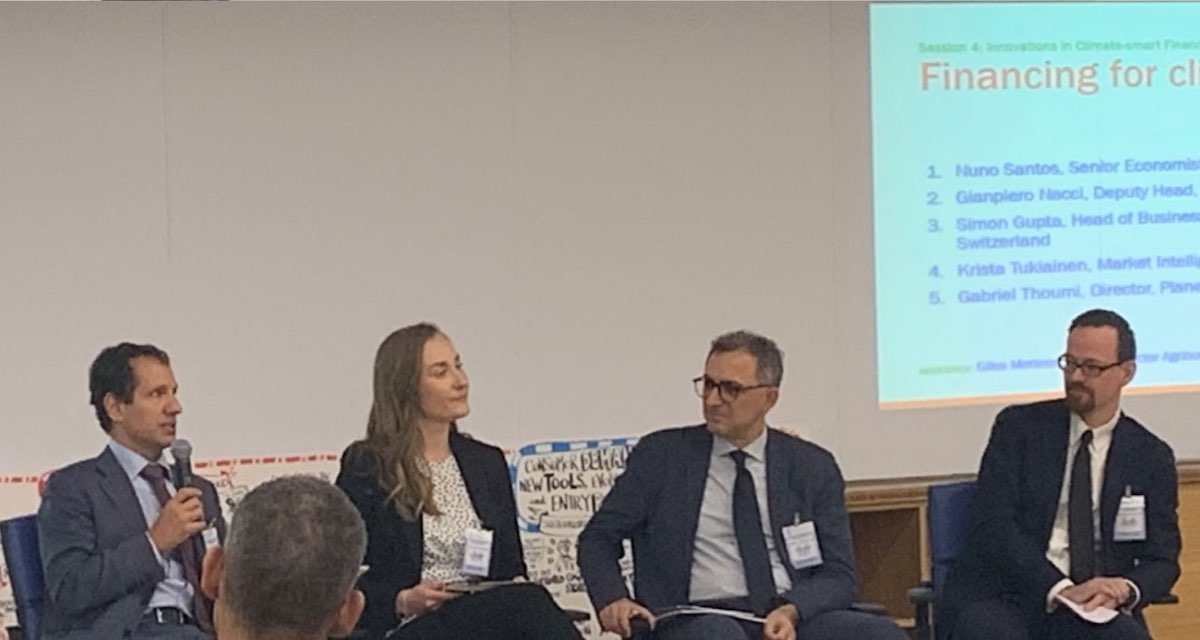
At the Food and Agriculture Organization’s annual Investment Days in December 2019, Planet Tracker, alongside leaders from FAO, the European Bank for Reconstruction and Development (EBRD), ResponsAbility Investments and the Climate Bonds Initiative, called on the global capital market to join Planet Tracker’s New Year’s Resolutions and make the decade of the 2020s about mitigating emissions associated with food and agriculture.
The global food and agriculture system faces an immediate risk and scale problem.
While the agriculture sector contributed $3.3 trillion to the global economy in 2018,[i],[ii] the sector – from farm to fork and from timber to house – was responsible for 37% of global greenhouse gas (GhG) emissions.[iii]
If the 2000s were about educating capital markets on climate change impacts and the 2010s were about capital markets beginning to address fossil fuel emissions, the 2020s are going to be about capital markets tackling emissions from food and agriculture systems.
So, let us ask a simple question: are these emissions being systematically addressed in capital markets today? We can start by looking at both exchanges and companies whose shares trade on these exchanges.
When companies raise capital on exchanges and then trade their shares on the same exchanges, they must comply with an exchange’s listing standards, which require a company to meet certain criteria to raise capital and then trade shares on an exchange.
Yet none of the 250 exchanges globally, where more than 48,000 publicly listed companies trade shares valued at more than $70 trillion, mandate that companies report GhG Scope 1, 2 and 3 emissions associated with their food and agriculture activities.
In other words, as we enter the 2020s, not one exchange globally is requiring companies to address 1/3 of the problem associated with climate change – the 37% of emissions associated with food and agriculture activities.
Planet Tracker’s New Year’s Resolution No. 1 is to require all 48,000 publicly traded companies report the GhG Scope 1, 2, 3 emissions associated with their food and agriculture activities since nearly every company uses fibre and food.
Yet many companies get loans from banks. So, banks finance a lot of the GhG emissions associated with food and agriculture activities.
Let’s look at 2017 when global syndicated loans were $4.3 trillion. In the same year, ING issued the first green loan to an agriculture trader tied to an emissions commitment, a $150 million loan to agriculture giant Wilmar where the interest rate charged to Wilmar depended on Wilmar achieving sustainability key performance indicators – including GhG emissions commitments. $150 million is a pittance compared to the global total syndicated loan volume of $4.3 trillion in 2017.
Yet there is no regulatory system globally that requires banks, such as ING and others, to both disclose and stress test their financial solvency and capitalization ratios specifically for GhG Scope 1, 2, and 3 emissions associated with food and agriculture activities.
For example, regulatory stress tests for solvency and capitalization such as Dodd-Frank and Basel III do not include GhG Scope 1, 2, and 3 emissions risks associated with food and agriculture activities despite the climate crisis negatively impacting non-performing assets.
Planet Trackers New Year’s Resolution No. 2 is to require all lenders globally to disclose and stress test their financing of GhG Scope 1, 2, 3 emissions associated with food and agriculture activities.
Now, let us look at portfolio managers. They must be addressing GhG Scope 1, 2, and 3 emissions associated with food and agriculture activities, right?
The Global Investment Performance Standards ® (GIPS) are the standard for investment performance analysis in global markets and used by over 1,700 investment firms including 24 of the largest 25 investors globally. About 85% of all GIPS investment performance analysis is verified by independent third-party auditors, thus ensuring compliance to GIPS and enabling consistent, accurate and fair disclosure.
But if we just look at the EU, 46 out of the EU’s 50 largest asset managers comply with GIPS. 87 of the top 100 largest global asset managers comply with GIPS. Over 1,630 asset managers globally apply GIPS. GIPS is ubiquitous. Yet none of the 37 most important food and agriculture dedicated equity funds we surveyed report GhG Scope 1, 2, and 3 emissions associated with food and agriculture activities.
Planet Trackers New Year’s Resolution No. 3 is to require asset managers to report GhG Scope 1, 2, and 3 emissions associated with food and agriculture activities in the same way they report their investment performance under GIPS.
So, when agriculture commodities trade on exchanges, they must report their emissions, mustn’t they?
No. Unfortunately, they do not.
Of the 500+ agriculture commodities that trade on the more than 30 agriculture commodity exchanges globally, a market that is estimated to be worth $5 trillion annually, not one exchange requires that commodities trading on their exchange report their GhG Scope 1, 2, and 3 emissions associated with the production and use of these agriculture products.
Planet Tracker’s New Year’s Resolution No. 4 is to require commodity exchanges to mandate that agriculture commodities trading on their exchanges report their GhG Scope 1, 2, and 3 emissions associated with food and agriculture activities.
As we enter a new decade, we ask everyone to support Planet Tracker’s New Year’s Resolutions by calling on equity and commodity exchanges, bank regulators and asset managers to mandate and report on GhG emissions from the products that transact in their marketplaces, from the investments they make and from the banks they regulate.
[i] The Economics of Ecosystems & Biodiversity (2019). TEEB for Agriculture & Food.
[ii] World Bank national accounts data, and OECD National Accounts data files (2018). Agriculture, forestry, and fishing, value added (current US$). Agriculture (code is NV.AGR.TOTL.CD) corresponds to ISIC divisions 1-5 and includes forestry, hunting, and fishing, as well as cultivation of crops and livestock production. Value added is the net output of a sector after adding up all outputs and subtracting intermediate inputs. It is calculated without making deductions for depreciation of fabricated assets or depletion and degradation of natural resources. The origin of value added is determined by the International Standard Industrial Classification (ISIC), revision 3. Data are in current U.S. dollars.
[iii] IPCC (2019). Climate Change and Land: an IPCC special report on climate change, desertification, land degradation, sustainable land management, food security, and greenhouse gas fluxes in terrestrial ecosystems.