
Global Toxic Footprints
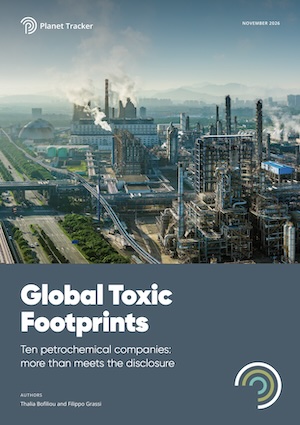
Global Toxic Footprints: Ten petrochemical companies – more than meets the disclosure
Toxic pollution can affect the financial performance of petrochemical companies and their investors. Regulations may increase costs, incidents can damage assets and interrupt production and lawsuits or remediation obligations can lead to long-term liabilities.
This report builds on Planet Tracker’s earlier studies in the US and Europe, by looking at the global operations of ten major petrochemical companies from 2019-2023, most of which also produce plastics. The report assesses air releases at 770 facilities, using two measures: toxicity-weighted air releases and carcinogenic air-release mass. The accompanying interactive dashboard broadens the analysis, allowing investors to explore facility-level releases to air, water and land using different pollution metrics, while distinguishing reported data from estimates.
Key findings
- Public emissions data leaves blind spots. Only 61% of the 770 facilities identified across the ten companies. For the other 39%, releases have been estimated.
- Toxicity weighted air releases are concentrated among a few companies. INEOS, Dow and BASF collectively account for 83% of assessed toxicity-weighted air releases among the ten companies, including estimates.
- Toxicity-weighted air-release intensity rose at most companies. Seven of the nine companies assessed for trends recorded an increase in toxicity-weighted air-release intensity in 2023 compared with 2022.
- A few facilities dominate each company’s totals. The three largest contributing facilities account for approximately 65% of INEOS’s, 50% of Dow’s and 55% of BASF’s assessed toxicity-weighted air releases, including estimates.
- SABIC, LyondellBasell and INEOS rank highest by carcinogenic air-release mass. Ineos is the only company among the top three under both measures.
- Progress is uneven across measures. A lower carcinogenic release mass does not always mean lower toxicity-weighted releases. From 2019 to 2023, Dow’s carcinogenic air-release mass dropped by 24%, but its toxicity-weighted releases increased by 45%.
Investor call to action
Investors should use the findings to strengthen engagement with petrochemical companies, including by:
- Demanding comprehensive disclosure of toxic chemical releases at facility and substance level across companies’ global operations.
- Pressing for time-bound pollution reduction plans, prioritising the largest contributing facilities and chemicals, with quantified capital expenditure, operating costs and annual milestones.
- Scrutinising reported changes by requiring companies to distinguish genuine pollution prevention from changes in production levels, operational incidents or reporting methods, and to disclose both absolute releases and emissions intensity.
- Strengthening corporate accountability through clear board-level responsibility and annual reporting against defined baselines.
- Investigating wider liabilities and financial exposure, including regulatory obligations, historical contamination, litigation, environmental provisions and insurance recoveries.
- Escalating engagement where progress is insufficient, through shareholder resolutions or votes on director elections, where applicable.
Thalia Bofiliou, report co-author and Senior Investment Analyst at Planet Tracker
“Toxic pollution is not simply an environmental issue. It can create significant costs through regulation, operational disruption and litigation. Investors need to know how companies are managing these risks and what they are spending to reduce releases.
Our research gives investors clear priorities: ask companies which measures can reduce releases at the facilities contributing most to their toxic footprints, what those measures would cost and when they can be delivered. Companies need credible, time-bound plans and evidence that they are delivering lasting pollution reductions.”