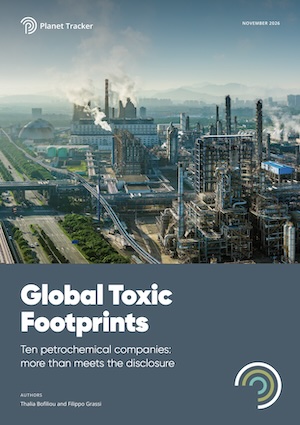
Petrochemical giants’ toxic pollution and disclosure gaps exposed in new research
Planet Tracker calls on investors to press for targeted reductions and comprehensive disclosure across companies’ global operations
London, 26 November 2026 – INEOS, Dow and BASF account for nearly 83% of assessed toxicity-weighted air releases across ten major petrochemical companies according to new research from financial think tank Planet Tracker. Toxic chemical releases can harm human health and the environment and create regulatory, operational and legal risks for companies. The research focuses on ten major petrochemical companies, building on Planet Tracker’s earlier US and European Toxic Footprints studies.
The report, Global Toxic Footprints, analyses toxic chemical releases across 770 facilities worldwide between 2019 and 2023 – the most recent common five-year period available across the public emissions record used. It combines public emissions records with estimates where records are unavailable. It identifies five key findings:
- Toxic releases are concentrated among a few companies. INEOS, Dow and BASF account for 82.9% of assessed toxicity-weighted air releases across the ten companies. SABIC and LyondellBasell lead on carcinogenic air-release mass, with 4.6 million kg and 4.5 million kg respectively over the five-year period.
- Toxicity-weighted air-release intensity rose at most companies. Seven of the nine companies assessed for trends recorded an increase in toxicity-weighted air-release intensity in 2023 compared with 2022.
- A few facilities dominate each company totals. The three largest contributing facilities account for approximately 65% of INEOS’s, 50% of Dow’s and 55% of BASF’s assessed toxicity-weighted air releases, including estimates. These sites provide clear starting points for investigating opportunities to reduce each company’s total releases.
- Public disclosure leaves major blind spots. Only 61% of the 770 facilities identified have publicly disclosed emissions, with releases from the remaining 39% being undisclosed. Public emissions data are available for just 33% of SABIC’s identified facilities, 40% of Braskem’s and 49% of LyondellBasell’s.
- Pollution can create material financial exposure. Regulatory compliance costs, operational disruption, damage to productive assets, litigation and remediation obligations can all affect companies’ financial performance. For example, Dow reported an estimated USD 43 million in property damage from explosions and fires linked to increased releases of ethylene oxide from its Plaquemine facility in Louisiana in 2023.
The findings follow the first International Conference of the Global Framework on Chemicals (GFC), held in Geneva from 16–20 November, where discussions highlighted the challenge of turning international commitments on chemicals and waste into funded, measurable action.
Planet Tracker’s research brings that challenge into focus for ten major petrochemical producers, identifying significant disclosure gaps and priority facilities and chemicals for investigating opportunities to reduce toxic releases. Investors can use the findings to press companies for comprehensive disclosure and credible, time-bound pollution reduction plans.
Thalia Bofiliou, report co-author and Senior Investment Analyst at Planet Tracker, said:
“Toxic pollution is not simply an environmental issue. It can create significant costs through regulation, operational disruption and litigation. Investors need to know how companies are managing these risks and what they are spending to reduce releases.
Our research gives investors clear priorities: ask companies which measures can reduce releases at the facilities contributing most to their toxic footprints, what those measures would cost and when they can be delivered. Companies need credible, time-bound plans and evidence that they are delivering lasting pollution reductions.”
Planet Tracker is calling on investors to use the findings to strengthen engagement with petrochemical companies, including by:
- Demanding comprehensive disclosure of toxic chemical releases at facility and substance level across companies’ global operations.
- Pressing for time-bound pollution reduction plans, prioritising the largest contributing facilities and chemicals, with quantified capital expenditure, operating costs and annual milestones.
- Scrutinising reported changes, requiring companies to distinguish genuine pollution prevention from changes in production levels, operational incidents or reporting methods, and to disclose both absolute releases and emissions intensity.
- Strengthening corporate accountability, with clear board-level responsibility and annual reporting against defined baselines.
- Investigating wider liabilities and financial exposure, including regulatory obligations, historical contamination, litigation, environmental provisions and insurance recoveries.
- Escalating engagement where progress is insufficient, through shareholder resolutions or votes on director elections, where applicable.
Notes to editors
The report, Global Toxic Footprints: Ten petrochemical companies – more than meets the disclosure, will be published on 26 November 2026 at 00.01GMT.
The report is accompanied by an interactive dashboard enabling investors to explore facility-level pollution data, examine reported institutional equity holdings and download company-specific engagement sheets to support targeted dialogue with companies.
Report page: https://planet-tracker.org/global-toxic-footprints/
Report PDF: https://planet-tracker.org/wp-content/uploads/2026/11/Global-Toxic-Footprints.pdf
Dashboard: https://planet-tracker-global-toxic-footprints.streamlit.app/
The research assesses ten companies: BASF, Braskem, Chevron Phillips Chemical, Dow, Evonik Industries, INEOS, LyondellBasell Industries, SABIC, Shin-Etsu Chemical and Toray Industries.
The analysis covers 2019–2023 and combines publicly reported emissions with estimates for facilities lacking public records. Toxicity-weighted air releases measure relative potential hazard, not actual human exposure, health effects or financial liabilities.
To request an interview or a copy of the report please contact Greenhouse Communications at TrackerGroup@greenhouse.agency
About Planet Tracker
Planet Tracker is an independent financial think tank working to align capital markets with planetary boundaries. Through data-driven and investigative research, we assess the financial risks and opportunities arising from natural capital degradation and the transition to a nature-positive economy. Our work focuses on key global value chains across food, land and ocean systems, helping investors, policymakers and companies understand nature-related risks, challenge corporate behaviours, improve capital allocation and support more sustainable economic outcomes.