Valuing the global food system

Food Systems, Circularity, Equity

Planet Tracker has created an interactive dashboard to enable users to value the global food system by adjusting various valuation variables.

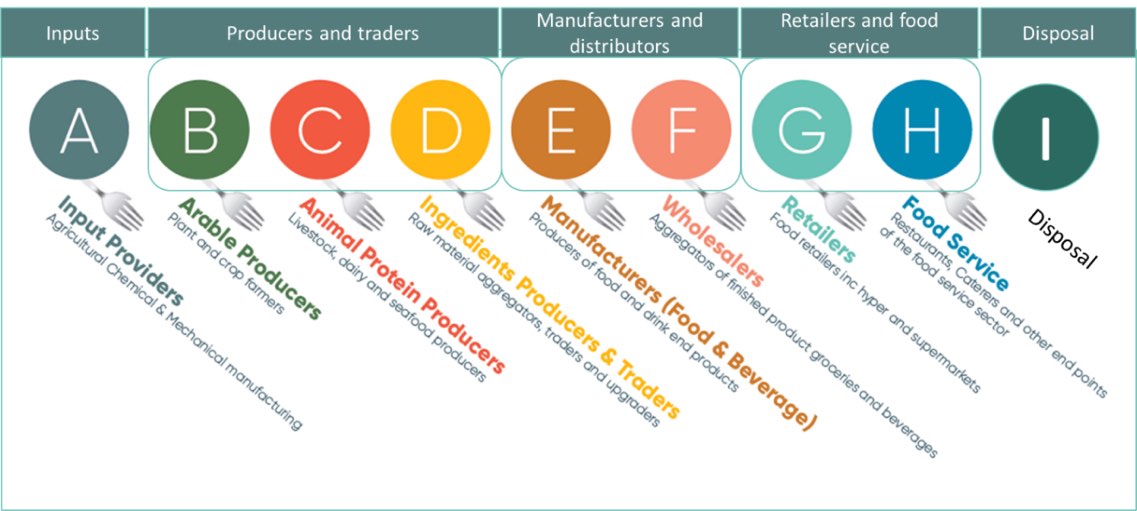
Planet Tracker defines the food system as commencing with input providers (e.g. agricultural chemicals and machinery) through to producers and traders, food & beverage manufacturers and distributors, and ending with the retailers, food service and waste companies – see Figure 1. Some could view the global food system as even larger, if suppliers to this industry, such as packagers or service providers, are included.

Figure 1: The global food system – node analysis (Source: Planet Tracker)

Valuing the global food system is a challenging task and involved the analysis of 400,000 companies connected to food. Planet Tracker was unable to gather accurate numbers on hundreds of millions of smallholder farmers or tens of millions of artisanal fishing and small aquaculture businesses. Moreover, further down the supply chain, our database does not include smaller food manufacturers and retailers.
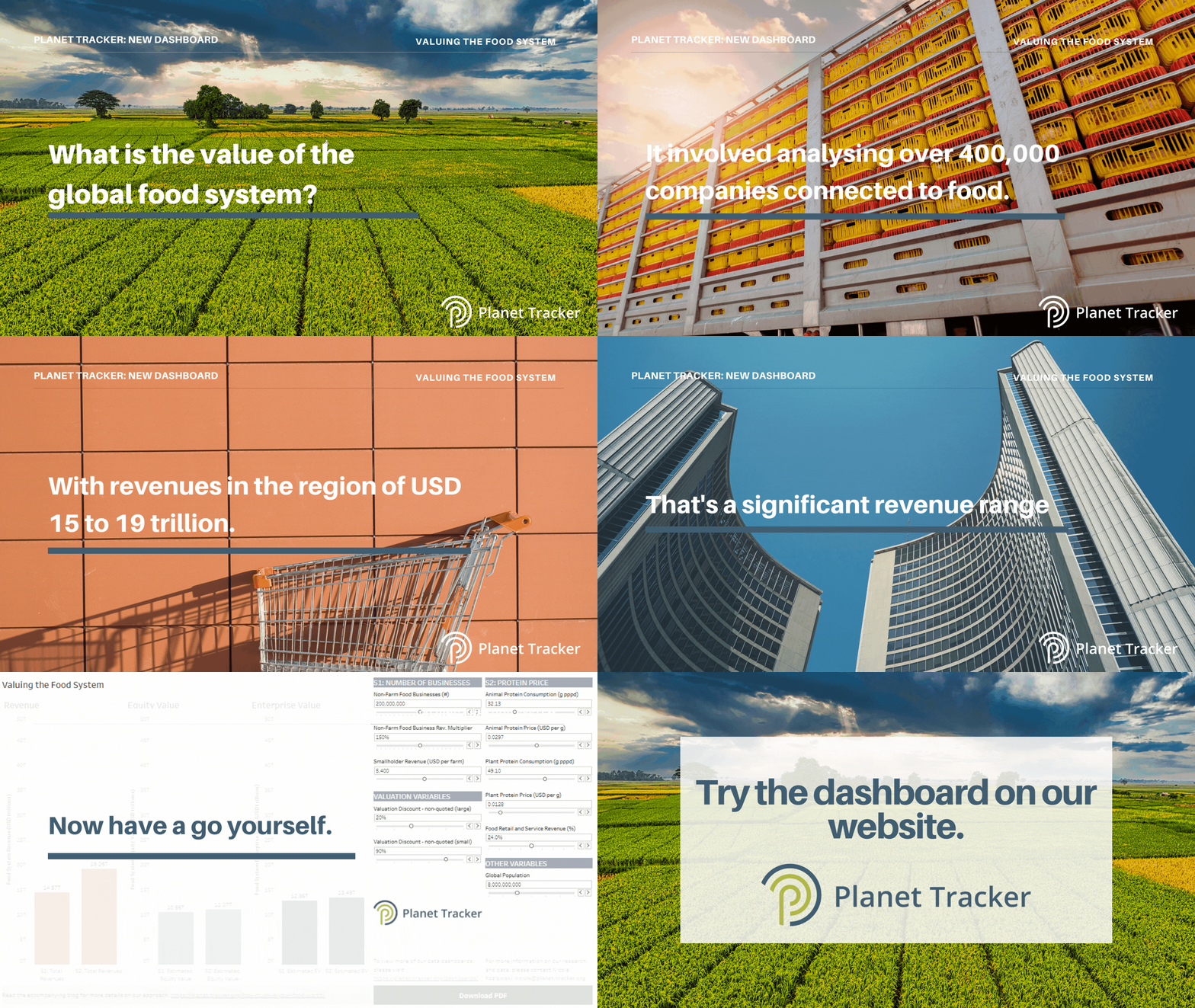
Planet Tracker estimated the enterprise value of the global food system to be around USD 14 trillion with revenues in the region of USD 15 to 19 trillion. This is equivalent to between 16 and 20% of GDP. It’s noteworthy that up to 70% of revenues come from 0.06% of all companies. For further details please see ‘How much is your food worth?’.

We recognise that we have provided a significant revenue range – although even at the lowest value in the range it clearly demonstrates the economic importance of the food system – and that we have had to make various assumptions.

For example, how many small- and medium-sized enterprises (SMEs) are there and what revenue multiples should be applied to them?

In the Planet Tracker Valuing the Food system dashboard, the user is able to adjust various valuation variables. We provide two main valuation approaches: Scenario 1 (S1) based on the number of businesses and Scenario 2 (S2) based on the protein price (both discussed in more detail in ‘How much is your food worth?’).

S1 uses a number of businesses approach. The aggregate revenue figure from the Planet Tracker food system database is used and then revenues are estimated for non-farm businesses (based on the number of businesses and a revenue multiplier compared to the assumed average smallholder revenue). This is added to the estimated smallholder revenue (510 million smallholders times an assumed average per farm) and these figures are added to the Planet Tracker database figure to calculate the overall revenue number.

S2 is based on protein prices. This model uses daily per person protein consumption levels, for both animal and plant proteins, combined with the price of this protein. The consumption data only relate to food sold through food retail and food service outlets so the revenue number must then be grossed up to provide a system-wide estimate (based on the assumed proportion of revenues coming from this part of the food system). Finally, the user can adjust for the global population.

In both instances, for the non-quoted companies, both large and small, a valuation discount may be applied. The displayed values will show the estimated revenue, equity and enterprise values.
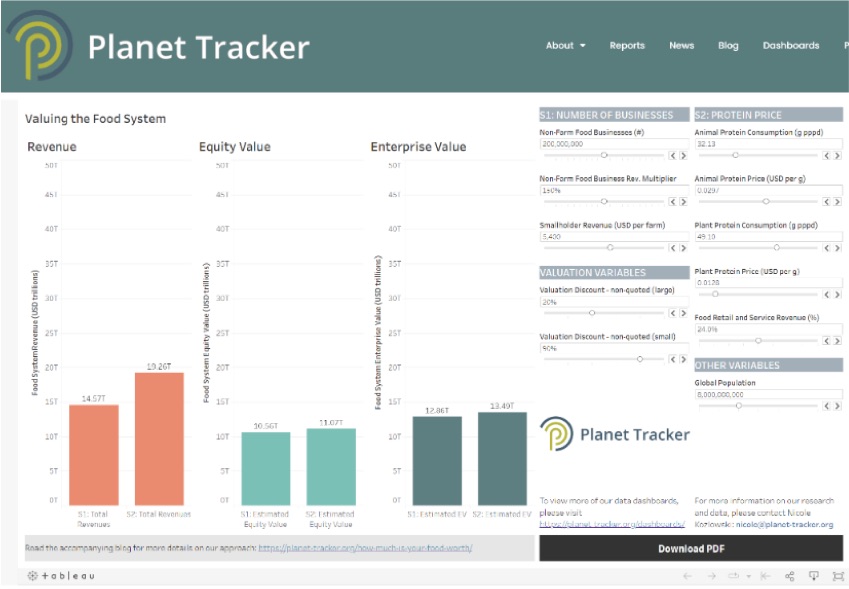
Figure 2: Valuing the Food System Dashboard (Source: Planet Tracker)

The latest reports to your inbox

Don’t miss out! To receive Planet Tracker's reports just click below and complete the contact form.
 

Sign up

Privacy Overview

Our Sites use cookies to enhance your experience while using those Sites. Cookies are pieces of information that some websites transfer to the computer or device that is browsing that website and are used for record-keeping purposes at many websites.

Our Sites may place and access certain first-party cookies on your computer or device. First-party cookies are those placed directly by us and are used only by us. We use cookies to facilitate and improve your experience of our Sites and to provide and improve our services. We have carefully chosen these cookies and have taken steps to ensure that your privacy and personal data is protected and respected at all times.

All cookies used by and on our Sites are used in accordance with current data protection and privacy law.

Before cookies are placed on your computer or device, you will be shown a prompt requesting your consent to set those cookies when you access one of our Sites. By giving your consent to the placing of cookies you are enabling us to provide the best possible experience and service to you. You may, if you wish, deny consent to the placing of all cookies, but you will not be allowed access to the site.

Certain features of our Sites depend on cookies to function. These cookies are sometimes known as “strictly necessary” cookies.

Our Sites also use analytics services provided by Google. “Google analytics” refers to a set of Google tools used to collect and analyse anonymous usage information, enabling us to better understand how the relevant Site is used. This, in turn, enables us to improve our Sites and the services offered through them.

The analytics service used by our Sites uses cookies to gather the required information. Our use of these analytics does not pose any risk to your privacy or your safe use of the relevant Site, however it does enable us to continually improve that Site, making it a better and more useful experience for you.

The analytics service used by our Sites uses the following cookies:

Name of Cookie First / Third Party Provider Purpose
Google Analytics Third Google For analysing use

In addition to the controls that we provide, you can choose to enable or disable cookies in your internet browser. Most internet browsers also enable you to choose whether you wish to disable all cookies or only third-party cookies. By default, most internet browsers accept cookies, but this can be changed. For further details, please consult the help menu in your internet browser or the documentation that came with your device.

You can choose to delete cookies on your computer or device at any time, however you may lose any information that enables you to access the relevant Site more quickly and efficiently including, but not limited to, login and personalisation settings.

It is recommended that you keep your internet browser and operating system up-to-date and that you consult the help and guidance provided by the developer of your internet browser and manufacturer of your computer or device if you are unsure about adjusting your privacy settings.

Social sharing links

We also use Google Analytics to track social shares made at our website. Google automatically collect and store certain information in their server logs which includes device event information such as crashes, system activity, hardware settings, browser type, browser language, the date and time of your request and referral URL, cookies that may uniquely identify your browser or your Google Account, in accordance with their data privacy policy: https://policies.google.com/privacy

Twitter:

We use a Twitter Tweet widget at our website. As a result, our website makes requests to Twitter’s servers for you to be able to tweet our webpages using your Twitter account. These requests make your IP address visible to Twitter, who may use it in accordance with their data privacy policy: https://twitter.com/en/privacy#update

LinkedIn:

We use a Linkedin Share widget at our website to allow you to share our webpages on Linkedin. These requests may track your IP address in accordance with their data privacy policy: https://www.linkedin.com/legal/privacy-policy