
The Shrinking Buffer: Climate change and the fragility of food
Niall Considine, Director of Research, Carbon Tracker and Planet Tracker
An exceptional El Niño, the closure of the Strait of Hormuz and attacks on Black Sea grain infrastructure are testing different links in the global food system. Together, they challenge its ability to absorb shocks.
Beyond these immediate pressures, climate change is likely to erode the buffers that have helped the system withstand disruption in the past.
The global food system faces a long-term threat from climate change. Through 2027, three immediate shocks will also test its resilience:
- Production: The latest ‘super’ El Niño is building towards a record-breaking peak around the end of the year, threatening crops and livestock.
- Inputs: The closure of the Strait of Hormuz has constrained fertiliser supplies, particularly phosphate, limiting access to the inputs needed to grow food.
- Storage and exports: Intensified attacks on Black Sea grain terminals have disrupted wheat exports and damaged Ukrainian storage and export capacity.
Conflict-related disruption to trade routes compounds these risks across the system.
Global food prices have risen only modestly overall, reflecting confidence in the system’s historical capacity to absorb and offset supply shocks. But this relative calm leaves a deeper question: can the system continue to withstand shocks of this scale and frequency over the longer term?
What current shocks reveal about longer-term risk
Climate change could weaken the food system’s ability to absorb episodic shocks in three ways:
- More frequent temperatures above the optimal ranges for food production;
- A greater risk of simultaneous production failures across major breadbaskets; and
- A higher risk of climate tipping points that could compound these pressures.
- Rising temperatures narrow the safe growing window for crops
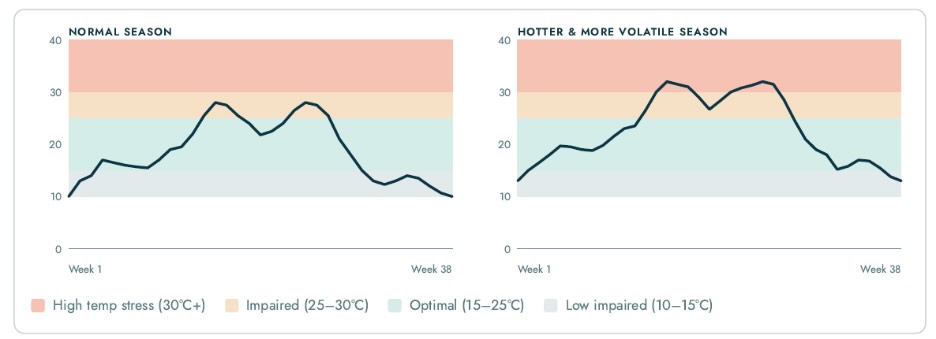
Hotter, more volatile seasons increase the time crops spend above optimal temperatures, raising the risk of lower yields and crop failure.
Source: Carbon Tracker Initiative and Planet Tracker – illustration
Key findings
- Extreme heat: The likelihood of extreme heat days is roughly twice as high at 2°C of warming as at 1.5°C, and four times as high at 3°C.
- Simultaneous crop failures: One cited study estimates that the potential for multiple maize breadbasket failures could reach 54% at 2°C of warming—equivalent to roughly once every two years.
- Food inflation: Climate-related production impacts could create persistent price pressures. A 2024 Potsdam Institute report estimates that they will add 0.9–3.2% to the annual rate of global food inflation by 2035.
- Adaptation finance: Funding for Agriculture, Forestry and Other Land Use (AFOLU) fell to $5.5 billion in 2024, compared with estimated adaptation costs of $80 billion a year.
Implications for policymakers and investors
For policymakers
Treat food security and resilience as a whole-of-government priority, strengthening the buffers that help the global food system absorb shocks.
- Map critical dependencies across supply chains.
- Stress-test national and global food systems against simultaneous harvest failures, fertiliser disruptions and export restrictions.
- Mobilise public and private capital to strengthen dependable food production.
For investors
Recognise food systems as a key channel through which climate change affects the real economy. Rising temperatures and climatic volatility can reduce production, disrupt supply chains, raise inflation and weaken economic growth, with consequences for asset prices and financial stability.
Ensure that the climate scenario models informing long-term asset allocation capture these interconnected food-system risks.
Author’s quote: “The relative calm of food commodity markets in the face of near-term supply risks should not be mistaken for longer-term resilience. Climate change will narrow the system’s margin for error by increasing heat stress, raising the risk of simultaneous crop failures and weakening the buffers that have helped absorb disruption in the past.” Niall Considine, Director of Research, Carbon Tracker and Planet Tracker