Plastics industry ‘all wrapping and no substance’ as it fails to tie compensation to sustainability goals
Analysis from Planet Tracker finds nearly half of plastic companies have no link between executive pay and sustainability goals, despite nearly all being publicly committed to sustainability policies
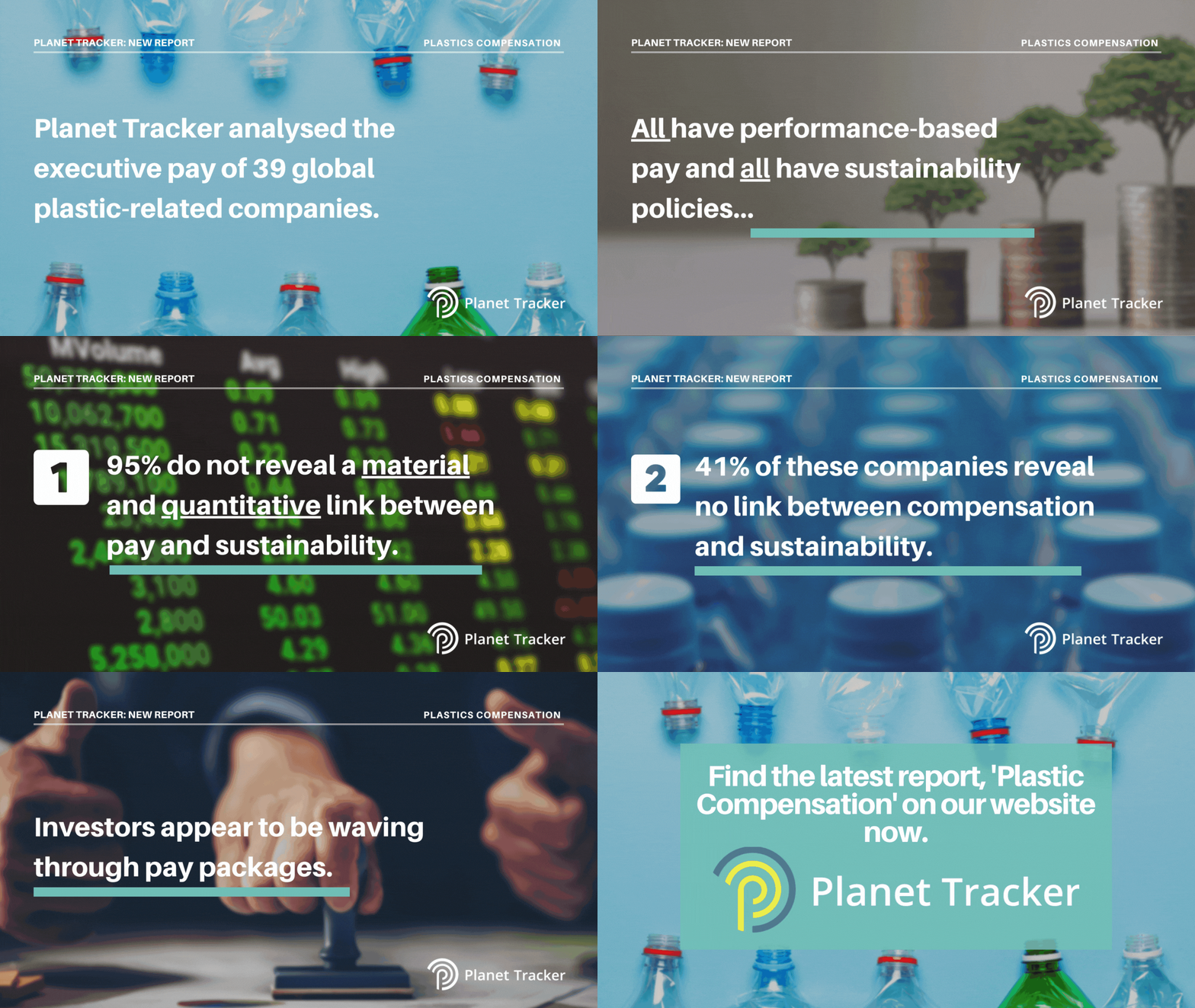
- 95% of leading plastic players fail to have a sufficient link between executive pay and sustainability factors, according to Planet Tracker’s research
- Nearly half (41%) of plastic companies lack any link between sustainability practices and executive compensation, a key requisite of a credible sustainability plan according to Planet Tracker
- Over half (54%) of companies do not set Science-based targets, with Planet Tracker highlighting the importance of independently verified sustainability targets
- With the top 25 independent shareholders holding a combined USD 1.1 trillion and the plastic industry facing one of the longest risk registers of any sector, Planet Tracker calls on investors to extend pay performance policies beyond purely financial metrics and include sustainability-linked elements.
London, 20 September 2023: Today, Planet Tracker releases a new report “Plastics – Executive Compensation”, analysing the pay-performance plans of 39 leading plastic players, including ExxonMobil, Saudi Aramco, Costco and Mars.
The report found the industry is failing to tie executive pay to environmental, social and governance (ESG) performance, despite facing one of the longest risk registers of any sector.
The findings reveal that while all companies release sustainability policies, almost half (43%) have no link between ESG deliverables and pay at all. Planet Tracker notes that all companies have pay-performance policies in place, but without incorporating ESG metrics, and management is not held to account for pressing sustainability objectives.
Planet Tracker’s research finds that the approaches of most companies (23) which do align compensation with ESG performance are insufficient, as they lack a quantitative link or only tie a minimal proportion of compensation to sustainability performance.
To ensure remuneration programmes create meaningful change, companies should set clear, quantitative annual targets linked to sustainability improvement. These should also be ‘material’, which Planet Tracker presently defines as having at least 10% of compensation tied to sustainability measures. The report identified only two companies – Ahold Delhaize and Danone – as meeting these requirements.
The study also found that over half (52%) of companies do not have science-based targets, with Planet Tracker emphasising the importance of independently verified target setting as they allow investors to rule out greenwashing and compare companies.
Thalia Bofiliou, Senior Investment Analyst (Plastic) at Planet Tracker, comments: “It’s a positive sign that all plastic companies we analysed are committed to wider sustainability goals. However, without meaningfully tying executive pay with sustainability metrics, this is all wrapping and no substance.
“To reduce the significant risks the plastic industry faces, from CO2 emissions and microplastics to new regulations, investors can no longer afford to wave pay packages through that aren’t linked to sustainability-related elements. It’s also imperative that these are material and quantifiable, rather than minimal percentages of compensation or vague goals for the future”.
Given that the top 25 independent shareholders, including Vanguard, BlackRock, State Street Capital Group and FMR, hold a combined USD 1.1 trillion in these companies, the report calls on investors to uphold effective sustainability-linked performance pay, by ensuring:
- Performance-linked pay is material: companies should set a meaningful (10%+) percentage of compensation at risk based on sustainability performance
- Targets and results are independently verified: companies should align with initiatives such as SBTi, which requires companies to set and disclose specific targets
- Targets are quantitative: sustainability targets should be clear and quantitative, similar to profit targets
- Targets are annual as well as long-term: targets should be annual, rather than vague indications of direction of travel
- Sustainability targets are independent from financial targets: targets should be independent of rather than subordinate to profitability targets
- Achievements are clearly disclosed: companies should disclose what has and has not been delivered, rather than reporting on direction of travel only
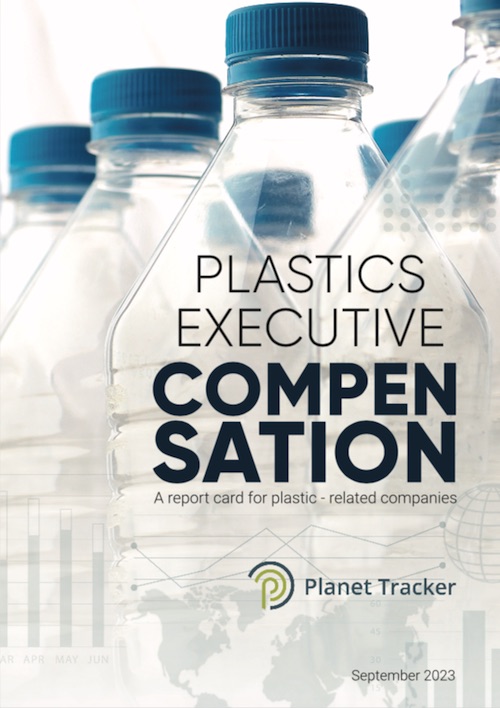
Plastics – Executive Compensation: A report card for plastic-related companies can be downloaded in full here.
A Best Practice Guide can be downloaded here
ENDS
For more information please contact:
Izzy Schaw Miller, ESG Communications | t: +44 0790 561 9881 | izzy@esgcomms.com
ABOUT PLANET TRACKER
Planet Tracker is a non-profit financial think tank producing analytics and reports to align capital markets with planetary boundaries. Our mission is to create significant and irreversible transformation of global financial activities by 2030. By informing, enabling and mobilising the transformative power of capital markets we aim to deliver a financial system that is fully aligned with a net-zero, nature-positive economy. Planet Tracker proactively engages with financial institutions to drive change in their investment strategies. We ensure they know exactly what risk is built into their investments and identify opportunities from funding the systems transformations we advocate.