Planet Tracker proposes global strategy to address rising stranded asset risk in the plastic containers and packaging sector
Twofold environmental and concentration risk is an investor opportunity to incite the sector to transition towards sustainable products and processes, says new report by financial think tank
LONDON, 30 March 2021. The most familiar environmental issue associated with plastics is packaging waste. Accounting for 36% of all plastic produced, plastic packaging – much of which remains single-use – is increasingly recognised by consumers and policymakers for its damaging environmental impact. Yet, supported by their investors, the plastic containers and packaging (PC&P) sector could avoid the build-up of negative pressure by implementing a global business strategy by 2025 that migrates their business platforms in a time-bound manner towards sustainable practices and a circular economy model.
Indeed, the PC&P sector is at an inflection point. While its existing technologies are directly associated with environmental harm, newer technologies – which could support an evolution in sustainable plastics and lead the PC&P sector into a circular economy – are not yet being invested in at scale.
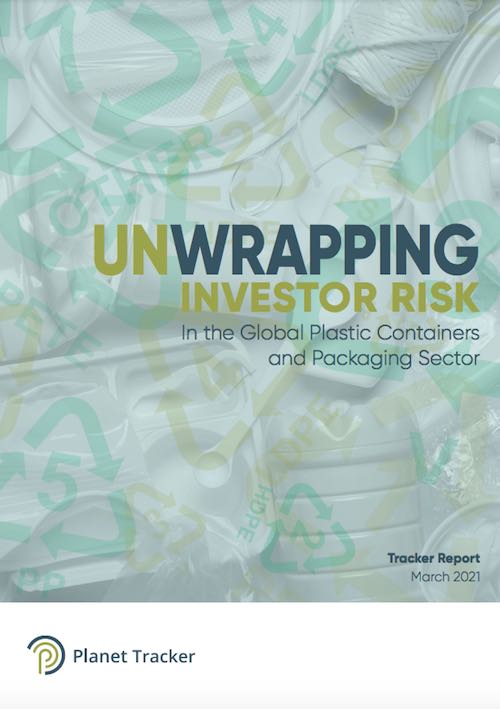
In a new report published today, Planet Tracker highlights how this scenario should be posing a serious concern for investors with regards to the rising probability of stranded assets.
The report identified 83 publicly traded global companies in the PC&P sector (the Planet Tracker Universe) whose annual plastic revenue is at least 10% of each company’s total revenue and exceeds USD 100 million. Combined, these companies have an estimated USD 54 billion in annual revenue and USD 126 billion market capitalisation. However, these figures disguise the concentration risk apparent in the sector, with 20 of the largest players accounting for 62% of the sector’s revenue, and a combined market capitalisation of USD 82 billion.
PC&P companies must establish a coherent plan to transition to more sustainable processes and products. Out of the 83 companies, 53 report no policies on key sustainable packaging-related topics and few reflect the rising risk of legislation in their company filings.
Meanwhile, the top twenty institutional investors in the Planet Tracker Universe have unrealised gains of USD 7.7 billion in 447 investments, led by Vanguard with USD 1.9 billion. Total unrealised gains in the Universe amount to USD 24 billion held in 8,665 investments surveyed by Planet Tracker.
This twofold environmental and concentration risk should be sending a clear warning to investors to incite PC&P companies to transition towards sustainable products and processes, before external pressures – such as government and regulatory policies – force them to do so. Failing this, the risk of stranded assets grows further, as companies may be unable to re-tool their production facilities fast enough, resulting in investment impairments, write-downs and write-offs, something presently being played out in the oil and gas sector.
Gabriel Thoumi, Head of Plastics Programme and Director of Financial Markets, Planet Tracker said: “The PC&P sector cannot feign ignorance at the mounting problem that is plastic pollution. With policymakers and consumers advocating for change and action at FMCG companies, the pressure is on for PC&P companies to act before these problems are further compounded.”
He added: “Investors have an important role to play in encouraging and supporting PC&P companies in this transition. If they want to realise their potential investment gains, they need PC&P companies to be fully aware of the growing pressure to reduce plastics pollution and to be taking mitigating actions to address these risks.”
In light of this, the report recommends that stakeholders take the following actions:
- All investors should immediately request public disclosure of environmental risks and policies from all 83 publicly traded PC&P companies identified in the report, in order to safeguard their unrealised investment gains, as well as assess the likelihood of incurring stranded assets and write-downs.
- All companies in the Planet Tracker Universe must individually or collectively recognise the impending risks in their filings and describe their transition strategy towards a circular economy.
- Policymakers and regulators need to work directly with investors and companies throughout the supply chain to simplify product design, reduce the complexity of packaging and harmonise packaging formats, grow the adoption of recyclable feedstocks, increase recyclable infrastructure and improve consumer outreach, so that plastics pollution can be rapidly mitigated and addressed.
In addition, 70% of the Planet Tracker Universe’s corporate bonds and loans are rolling over by 2025, creating an opportunity for some of these PC&P companies to convince investors they should be worthy of issuing green fixed income instruments. Conversely, the largest fixed income investors in this industry, led by BlackRock, J.P. Morgan, Prudential and Robeco, have a clear opportunity to set the investor agenda for these publicly traded companies with regards to how they will coalesce around a vision to support a transition to sustainable practices and a circular economy.
– END –
Notes for editors
ABOUT PLANET TRACKER
Planet Tracker is a non-profit financial think tank aligning capital markets with planetary boundaries. It was created primarily for the investor community to analyse the risk of market failure related to environmental limits which, other than climate change, are often not aligned with investor capital. Planet Tracker generates breakthrough analytics to redefine how financial and environmental data interact with the aim of changing the practices of financial decision makers to help avoid both environmental and financial failure.
Find out more: www.planet-tracker.org
PLASTICS TRACKER
The goal of Plastics Tracker is to stem the flow of environmentally damaging plastics and related products that are creating global waste and health issues. By taking a financial lens and using financial analytics to transparently map capital flows and influences in the mid-stream of the supply chain from resins production through to product use, Plastics Tracker seeks to stop unsustainable practices while encouraging investment in sustainable solutions.
Media contact
Ronak Anand
Moorgate Communications, a Finn Partners company
ronak.anand@finnpartners.com
+44 20 7539 3578

This work is licensed under the Creative Commons Attribution-NonCommercial-ShareAlike 4.0 International License. To view a copy of this license, visit http://creativecommons.org/licenses/by-nc-sa/4.0/ or send a letter to Creative Commons, PO Box 1866, Mountain View, CA 94042, USA.