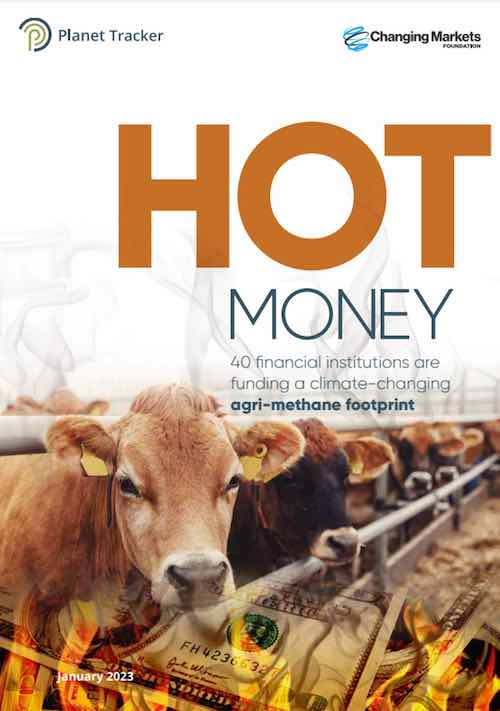
New report reveals the 40 financial institutions funding the world’s climate-changing methane problem
A new report by Planet Tracker and Changing Markets reveals the top financial institutions funding the world’s biggest methane producers, and the role they can play in turning the tide on global heating.
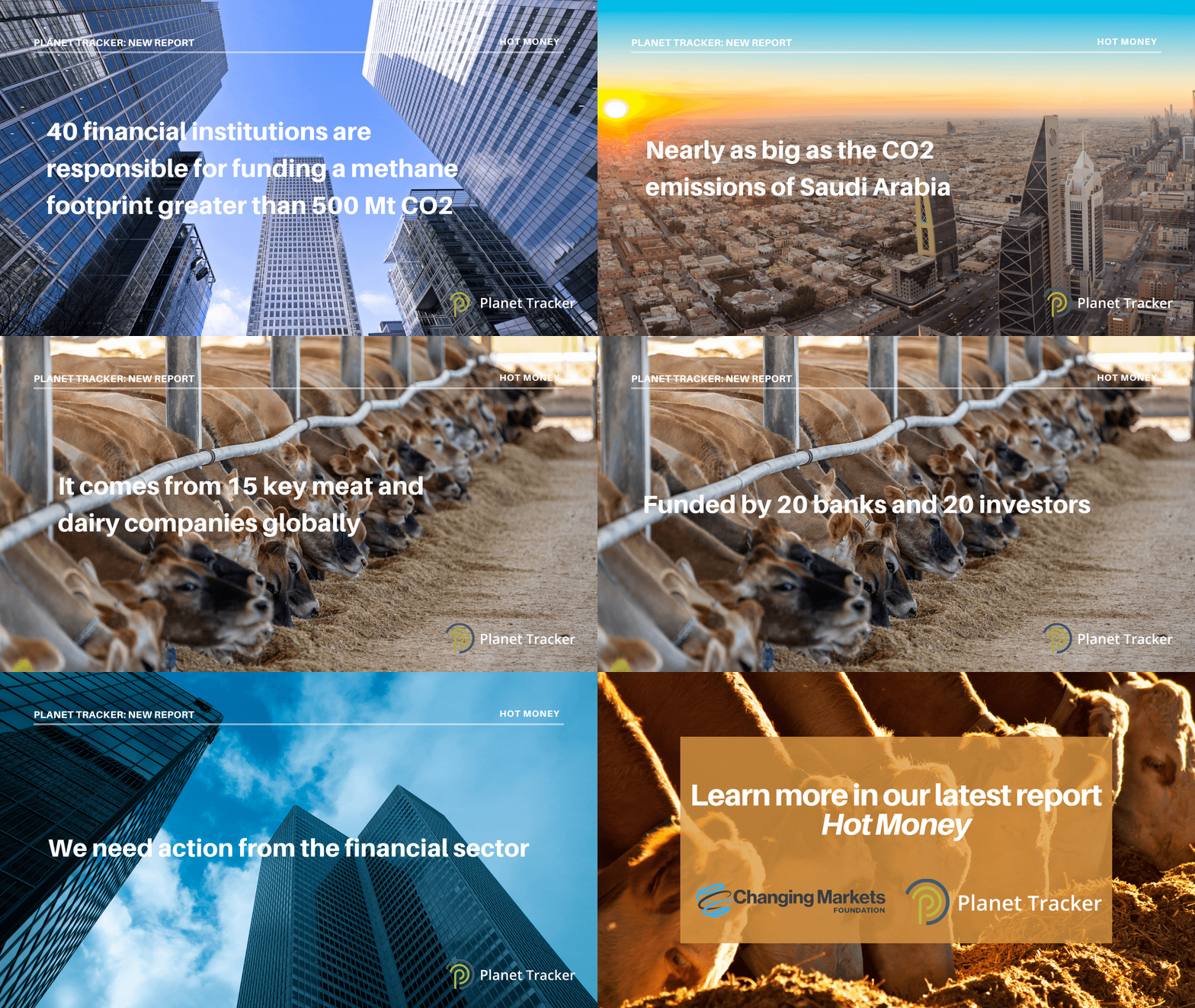
LONDON, 17 January 2023: A new report from financial think tank Planet Tracker and the Changing Markets Foundation has uncovered the 40 financial institutions responsible for funding a methane footprint that could exceed 500 Mt CO2e – nearly as big as the CO2 emissions1 of Saudi Arabia.
Hot Money names the 20 investors and 20 banks currently financing the methane-generating activities of fifteen leading global meat and dairy companies, identified in terms of equity ownership, bond ownership and bank funding. All were found to have weak or non-existent policies for reducing methane emissions, with a particular gap regarding livestock agriculture – the single largest source of agri-methane. This conflicts with the Global Methane Pledge signed by all but one of the institutions’ home countries.
The aggregate agri-methane footprint attributable to the top 20 equity investors is 68 Mt CO2e – more than the CO2 emissions of Austria. Vanguard takes first place, with Blackrock second and State Street third. For banks, the footprint is roughly three times as large (c. 200 Mt CO2e) – almost equivalent to the CO2 emissions of countries like Spain. Because of its focus on meat, Morgan Stanley takes the top slot (40 Mt CO2e), followed by JP Morgan (31 Mt CO2e) and HSBC (19 Mt CO2e). The estimated methane footprint of the banks could easily be higher – a harsher estimation method would suggest a footprint for the banks of over 430 Mt CO2e – equivalent to Brazil’s annual CO2 emissions.
Peter Elwin, Director of Fixed Income and Head of Food and Land Use Programme at Planet Tracker, comments: “Methane is a powerful climate pollutant, 80 times worse than CO2 over a 20-year period.
“This report highlights the significant role that financial institutions have to play in limiting agricultural methane emissions. Food production generates more methane than the energy system so if asset managers want to achieve net zero in their portfolios, they need to address the issue of agri-methane.
“The good news is that it is comparatively short-lived – methane breaks down in the atmosphere, reducing to half its level in around 11 years. Cutting methane emissions gives financial institutions the greatest bang for their buck enabling them to rapidly reduce the GhG footprints they fund. More importantly, tackling methane emissions now will have an amplified positive impact in slowing global heating before 2050”.
Nusa Urbancic, Campaigns Director at Changing Markets Foundation, said: ”The emissions in the meat and dairy sector are highly concentrated, with just a handful of meat and dairy companies responsible for 1 in every 10 tonnes of methane produced by livestock. It is disappointing that at a time when we desperately need strong climate leadership, the finance sector is missing in action when it comes to addressing this potent gas. They must join the methane momentum sparked by the Global Methane Pledge and demand urgent corporate action to cut methane, starting at this year’s upcoming AGM season”.
Methane is a powerful climate pollutant that, over a twenty-year period, has a global warming potential 80 times worse than CO2. Scientists say that cutting methane is one of the most effective ways to stay on 1.50 pathway and have called for 40-45% reduction in methane emissions by 2030. At COP26 in Glasgow, the Global Methane Pledge was launched, where governments have committed to at least 30% reductions by 2030. The Pledge currently has over 150 signatories.
Planet Tracker and Changing Markets call on financial institutions to:
- Require the companies they fund to have clear policies and procedures to cut methane emissions, particularly those arising from agriculture (including Scope 3). Banks should include this requirement within their lending agreements.
- Demand that energy, meat and dairy companies publish quantified, independently verified, full methane emission disclosure (Scope 1, 2 and 3) by product line and geography, on a timely basis.
- Require the food production companies they fund to publish production data, by product line and geography, in their annual reports.
- Set an investment policy linked to quantitative, time-framed and science-based methane reduction targets. These need to extend to agriculture, in particular livestock, and should be integrated into their net zero strategy.
- Report annually on their progress with respect to limiting methane emissions, including those from agriculture.
Governments must also play their part by actioning the promises set out under the Global Methane Pledge, prioritising specific policies aimed at the reduction of emissions from livestock.
The 40 financial institutions revealed in this report are spread across the United States (15), Switzerland (6), France (5), Canada (4), UK (3), Germany (2), Netherlands (1), Spain (1), Japan (1), Italy (1) and China (1). China is the only host country that has not signed the Methane Pledge.
1 CO2 was compared rather than methane because methane calculations vary so CO2 provides a simpler benchmark. All country CO2 emissions data comes from the World Bank (https://data.worldbank.org/indicator/EN.ATM.CO2E.KT?most_recent_value_desc=true )
– ENDS –
ABOUT PLANET TRACKER
Planet Tracker is a non-profit financial think tank producing analytics and reports to align capital markets with planetary boundaries. Our mission is to create significant and irreversible transformation of global financial activities by 2030. By informing, enabling and mobilising the transformative power of capital markets we aim to deliver a financial system that is fully aligned with a net-zero, nature-positive economy. Planet Tracker proactively engages with financial institutions to drive change in their investment strategies. We ensure they know exactly what risk is built into their investments and identify opportunities from funding the systems transformations we advocate.
FOOD SYSTEM TRANSFORMATION PROGRAMME
The goal of the programme is to align capital markets with a sustainable global food system. Before 2050, Planet Tracker’s Food and Land Use Programme will highlight the investment risks and opportunities associated with the just and equitable transformation of the global food system that eliminates negative externalities with respect to climate, nature, and health so that it is fit to feed the world’s growing population within planetary boundaries. By highlighting these risks and opportunities, Planet Tracker’s Food and Land Use programme will influence financial markets actors to actively support and fund this transformation.
ABOUT CHANGING MARKETS
The Changing Markets Foundation was formed to accelerate and scale up solutions to sustainability challenges by leveraging the power of markets.
Working in partnership with NGOs, other foundations and research organisations, we create and support campaigns that shift the market share away from unsustainable products and companies and towards environmentally and socially beneficial solutions.
www.changingmarkets.org | @ChangingMarkets
Media contact
Annabel Rivero
Aspectus Group
planettracker@aspectusgroup.com
+44 7763113826