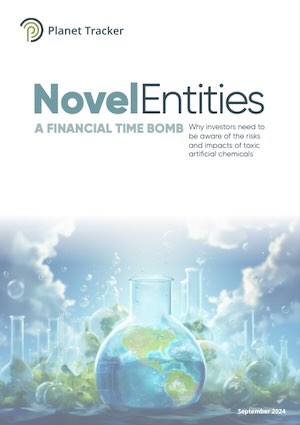
Investors face growing “toxicity debt” and increasing litigation from novel entities such as artificial chemicals and plastics

Report from Planet Tracker urges investors to address the financial risks associated with toxic chemicals, which are key drivers of environmental damage, as well as being responsible for chronic and acute impacts on human health.
- Production of novel entities – new substances, materials or organisms not previously known to the Earth system – is growing rapidly with a new chemical substance registered every 1.4 minutes.
- Novel entities exceed their planetary boundary, and while their long-term impacts remain largely unknown, they caused two million deaths and 53 million disability-adjusted life years (DALYs) per year.
- The USD 6 trillion chemical industry is increasingly exposed to hefty financial fines, such as 3M’s USD 10 billion litigation costs.
- Investors face near-term an estimated USD 20 billion in corporate liabilities from just plastic-related pollution – including chemical additives in plastics – in the US alone.
- Planet Tracker encourages investors to urgently reduce growing “toxicity debt” and review the risk premium they are presently assuming for companies associated with novel entities.
London, October 1, 2024: Planet Tracker’s latest report, ‘Novel Entities – A Financial Time Bomb’, presents a detailed analysis of the risks of one of Earth’s nine boundaries, novel entities. The report highlights their risk to both human and planetary health and warns investors of the significant financial risk they face from not considering their potential impact.
The release of novel entities — artificial chemicals and other human-made pollutants — into the biosphere, has accelerated to a point that they have exceeded their planetary boundary, threatening the Earth operating system, along with humanity.
While novel entities are often considered as innovation and technological advancement, they are responsible for significant health and environmental impacts, which caused two million deaths and 53 million DALYs in one year alone, as well as being key drivers of biodiversity loss and climate change.
Despite this, the production of novel entities is growing – a new chemical substance is registered every 1.4 minutes – and many of their impacts remain unknown. In Europe and North America alone, over 350,000 chemicals have been registered for production and use, and in Europe 80% of these are untested.
Why this matters for corporates and investors
The report highlights the potential litigation and reputational risk companies face from failing to address their production and use of toxic chemicals. Novel entities produced decades ago still pose financial liabilities for companies today and corporates are likely to be liable for damages even after ceasing their production and use. Companies linked to the production and use of harmful novel entities also risk reputational damage, particularly as awareness of the impact grows.
Science and innovation multinational 3M (MMM), for example, is set to pay USD 10 billion in litigation fines resolving claims that the company polluted water with PFAS, also known as “forever chemicals”. Bayer (BAY) also saw a significant part of its cashflow absorbed by ongoing litigation related to toxic chemicals claims in the last five years amounting to EUR 13 billion.
Moreover, between 2022 and 2030 investors could face USD 20 billion in corporate liabilities from just plastic related pollution – including chemical additives in plastics – in the US alone. Legal risks can in turn trigger profit warnings, asset sales, and dividend cuts.
John Willis, Director of Research at Planet Tracker, comments:
“The chemical industry is a powerful economic force, contributing about USD 6 trillion to global GDP and employing about 120 million workers. Rising plastic pollution and exposure to chemicals concern is an increasing source of both scientific study and lawsuits. As attempts are made to regulate novel entities, a growing “toxicity debt” exists, which can leave companies, and their investors, financially exposed for decades to come.
“The longer companies exposed to novel entities delay transitioning to sustainable alternatives, the greater their liabilities are likely to become. Investors need to ensure they are valuing these risks accurately and transition to more sustainable substances.”
Planet Tracker recently launched its petrochemical investor statement, whereby signatories call on petrochemical companies to:
- Transparently disclose and define strategies targets to reduce the impacts of plastics.
- Identify and address hazardous polymers and chemicals of concern in their products.
- Build sustainable infrastructure and publish well-defined capital expenditure plans to develop technology and infrastructure.
- Establish dedicated governance to increase responsibility and oversight for achieving plastic sustainability commitments.
- Support ambitious international legally binding instruments for ending plastic pollution, including the Montreal Protocol and the United Nations Global Plastic Treaty currently in development.
As of July 2024, USD 6.8 trillion of AUM, representing 73 investors, have signed the statement.
Novel Entities is part of a series Planet Tracker is publishing on planetary boundaries. For more information on the nitrogen planetary boundary, Fixing Nitrogen is available here.
Read the full report here.
For more information, please contact:
Izzy Schaw Miller, ESG Communications | t: +44 7905 619881 | izzy@esgcomms.com
About Planet Tracker
Planet Tracker is an award-winning non-profit financial think tank aligning capital markets with planetary boundaries. Created with the vision of a financial system that is fully aligned with a net-zero, resilient, nature positive and just economy well before 2050, Planet Tracker generates break-through analytics that reveal both the role of capital markets in the degradation of our ecosystem and show the opportunities of transitioning to a zero-carbon, nature positive economy.