Investing in Deep Sea Mining is a Financial Mistake

Deep Sea Mining, Financial Risk & Reward, Greenwashing, Transparency & Traceability, Equity

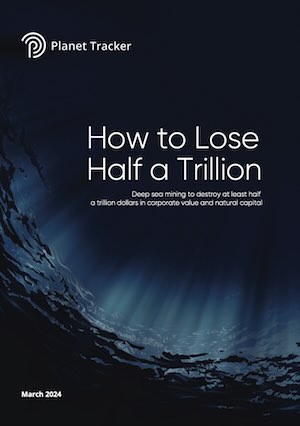
London 7 March 2024 – Betting on resource extraction over nature preservation is a financial mistake, according to Planet Tracker’s latest report, “How to Lose Half a Trillion“, which finds that sectors dependent on preserving intact ecosystems have outperformed those engaged in exploitation by threefold in terms of financial returns over the last three decades.

Correcting this mistake is crucial now, as ambitions crystallise to mine the deep sea. The analysis finds that chasing this ecological disaster could cause over USD 500 billion in value destruction, of which USD 30-132 billion in the mining sector itself.

“Before factoring in any environmental impacts, the economics already appear uncompelling”, says report lead author François Mosnier, Head of Oceans at Planet Tracker. “High operating expenditures mean that returns will be negative for investors in deep sea mining, which will also destroy value in other sectors, such as terrestrial mining and fishing”.

Moreover, the negative impact on the deep sea’s ecosystem services could lead to natural capital destruction of at least USD 465 billion, predominantly through habitat destruction.

However, there is a silver lining. Financial market participants have the power to prevent this potential loss of at least half a trillion dollars by endorsing a moratorium on deep sea mining.

“It is not often that financial markets can claim a major success in nature conservation while avoiding significant destruction to corporate value and natural capital. Preventing deep sea mining would be such an opportunity”, stated Mosnier.

The findings of this report underscore the need for a paradigm shift in the way financial markets perceive nature. By recognizing the inherent value in preserving ecosystems, investors have the potential to safeguard both the environment and their financial interests.

How to Lose Half a Trillion can be downloaded  here.

ENDS

For more information please contact:

Josh Hoppen, ESG Communications | t: +34 612 28 72 64 | josh@esgcommunications.com

ABOUT THE DEEP SIX PROJECT

This report is the third in a series of six (the ‘Deep Six Project’), focused on deep sea mining. Use the links to view the first two reports ‘The Sky High cost of Deep Sea Mining’, and ‘The Climate Myth of Deep Sea Mining’. The goals of the Deep Six project are to 1) assess the potential environmental impact of deep-sea mining, including in relation to equivalent land-based mining and 2) for investors to apply six different learnings from the risks and opportunities of deep sea mining to other industries that impact marine ecosystems, focusing on: climate change vs. nature considerations, resource-based valuations vs. natural capital value, restoration potential, circularity, sovereign risk and stranded assets risk.

ABOUT PLANET TRACKER 

Planet Tracker is an award-winning non-profit think tank focused on sustainable finance with the purpose of ensuring that capital markets’ investment and lending decisions are aligned with planetary boundaries and support a just transition. Its mission is to create transformation of global financial activities by 2030 to bring about real world change in our means of production so that they align with a resilient, just, net-zero and nature-positive economy. Planet Tracker serves both as a watchdog on corporate behaviour, including issues such as greenwashing, and as an ally to support finance and business to know how to undertake transition. By identifying the companies causing the worst environmental and social damage within targeted supply chains, Planet Tracker then identifies the investors and lenders in these companies whose financing is enabling these practices to continue unchallenged.

Privacy Overview

Our Sites use cookies to enhance your experience while using those Sites. Cookies are pieces of information that some websites transfer to the computer or device that is browsing that website and are used for record-keeping purposes at many websites.

Our Sites may place and access certain first-party cookies on your computer or device. First-party cookies are those placed directly by us and are used only by us. We use cookies to facilitate and improve your experience of our Sites and to provide and improve our services. We have carefully chosen these cookies and have taken steps to ensure that your privacy and personal data is protected and respected at all times.

All cookies used by and on our Sites are used in accordance with current data protection and privacy law.

Before cookies are placed on your computer or device, you will be shown a prompt requesting your consent to set those cookies when you access one of our Sites. By giving your consent to the placing of cookies you are enabling us to provide the best possible experience and service to you. You may, if you wish, deny consent to the placing of all cookies, but you will not be allowed access to the site.

Certain features of our Sites depend on cookies to function. These cookies are sometimes known as “strictly necessary” cookies.

Our Sites also use analytics services provided by Google. “Google analytics” refers to a set of Google tools used to collect and analyse anonymous usage information, enabling us to better understand how the relevant Site is used. This, in turn, enables us to improve our Sites and the services offered through them.

The analytics service used by our Sites uses cookies to gather the required information. Our use of these analytics does not pose any risk to your privacy or your safe use of the relevant Site, however it does enable us to continually improve that Site, making it a better and more useful experience for you.

The analytics service used by our Sites uses the following cookies:

Name of Cookie First / Third Party Provider Purpose
Google Analytics Third Google For analysing use

In addition to the controls that we provide, you can choose to enable or disable cookies in your internet browser. Most internet browsers also enable you to choose whether you wish to disable all cookies or only third-party cookies. By default, most internet browsers accept cookies, but this can be changed. For further details, please consult the help menu in your internet browser or the documentation that came with your device.

You can choose to delete cookies on your computer or device at any time, however you may lose any information that enables you to access the relevant Site more quickly and efficiently including, but not limited to, login and personalisation settings.

It is recommended that you keep your internet browser and operating system up-to-date and that you consult the help and guidance provided by the developer of your internet browser and manufacturer of your computer or device if you are unsure about adjusting your privacy settings.

Social sharing links

We also use Google Analytics to track social shares made at our website. Google automatically collect and store certain information in their server logs which includes device event information such as crashes, system activity, hardware settings, browser type, browser language, the date and time of your request and referral URL, cookies that may uniquely identify your browser or your Google Account, in accordance with their data privacy policy: https://policies.google.com/privacy

Twitter:

We use a Twitter Tweet widget at our website. As a result, our website makes requests to Twitter’s servers for you to be able to tweet our webpages using your Twitter account. These requests make your IP address visible to Twitter, who may use it in accordance with their data privacy policy: https://twitter.com/en/privacy#update

LinkedIn:

We use a Linkedin Share widget at our website to allow you to share our webpages on Linkedin. These requests may track your IP address in accordance with their data privacy policy: https://www.linkedin.com/legal/privacy-policy