International Sustainable Finance Redux

Sustainable Finance negotiations at a multilateral level are restarting. Governments are setting the scene for international discussions with major power blocks involved – China, EU, UK, US – under the auspices of the G20. However, will the international community be able to reach an agreement? And will biodiversity issues be able to leverage progress on climate change? Corporates and the financial sector should watch these developments carefully.
Last week, the Italian G20 Presidency, with the US and China as co-chairs and with UNDP as the secretariat, held the first Sustainable Finance Study Group (SFSG) within the G20 Finance track. Although not a new idea – it was originally created in 2016 under the Chinese G20 Presidency and called the Green Finance Study Group – it finished after delivering one report and three further updates.[1]
The Sustainable Finance Study Group’s objective is the development of a multi-year G20 Roadmap for Sustainable Finance which will tackle major gaps and barriers in mobilising sustainable finance. In addition, it aims to outline key actions and milestones for the consideration of G20 Members.
A recent press release states that the SFSG will ‘produce a synthesis report on the progress made on the main deliverables for 2021: sustainability reporting, approaches to identify sustainable investments (“taxonomies”), and the role of international financial institutions in supporting the Paris Agreement’.[2]
We are encouraged by the fact that this is part of an orchestrated approach in a busy year for the sustainability agenda. Figure 1 illustrates some of the high-level events taking place this year (source: G20 & Planet Tracker).
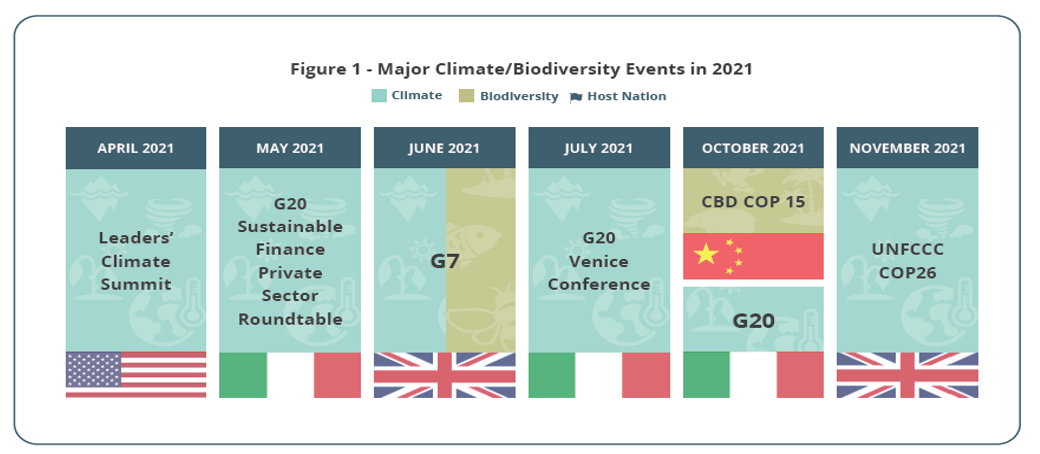
Major economic powers are clearly involving themselves in the sustainable finance agenda by actively participating and organising roundtables at home and abroad.
With the Biden Administration in office, the United States has re-emerged as a player in the climate space. The ‘Executive Order on Tackling the Climate Crisis at Home and Abroad’ states the objective of ‘putting the climate crisis at the center of United States foreign policy and national security’. In addition, the Administration has set specific objectives which include re-joining the Paris Agreement, issuing new nationally determined contributions before the UNFCCC COP26 to be held in November of this year, reconvening the Major Economies Forum on Energy and Climate, namely the Leaders’ Climate Summit in April 2021, and actively participating by integrating climate ambition and consideration in several international fora, among which are the G7 and the G20.[3]
While the present Administration in the United States is actively working on promoting global climate talks, the EU and UK are continuing with their high-profile roles. Represented by Italy at the G20 and at COP26, which Italy is co-hosting with the UK, the EU is pushing forward with the European Green Deal, designed to ‘transform the Union’ into a sustainable economy.[4]
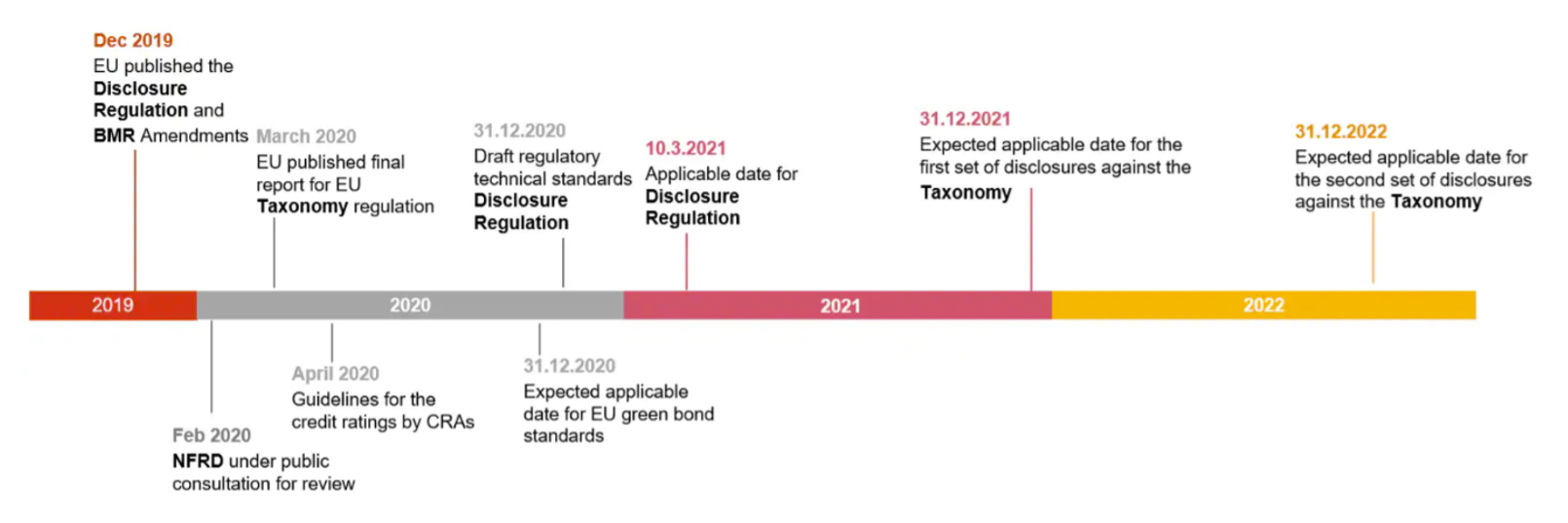
Figure 2. EU Sustainable Finance Regulation Timeline,[8] PWC[9]
These ambitions are already being given legal effect: the Sustainable Finance Taxonomy[5] (Taxonomy) and the Sustainable Finance Disclosures Regulation[6] have been adopted at EU level (see Figure 2). Planned future policy includes enactment of a renewed Non-Financial Reporting Directive[7] (NFRD) and issuing of technical regulatory standards in support of the Taxonomy.
As host of both the G7 and of the COP26, the UK has also declared its sustainable finance ambitions. On one hand, the UK Government sees the G7 as a relevant forum to build political momentum ahead of the above-mentioned events through ambitious action on the interdependent crises of climate change and of biodiversity decline.[10] The UK Government recently published ‘The Economics of Biodiversity: The Dasgupta Review’, which assesses the economic benefits of biodiversity, the economic costs and risks of biodiversity loss and identifies a range of actions that can simultaneously enhance biodiversity and deliver economic prosperity.[11] On the other hand, UK diplomats are committed to release, at COP26, a balanced negotiated package that delivers the Paris Agreement and moves the UN Climate Change process forward.[12]
The Chinese Government is also present at the sustainable finance debate, actively participating as co-chair of the Sustainable Finance Study Group within the G20 Finance track as well as hosting the 15th Convention on Biological Diversity (COP15) in Kunming this year.[13] China has been working domestically on sustainable finance with recent initiatives to assess the environmental performance of banks and update its national green bond standards.[14]
Although we recognise that there are certain obstacles to overcome, it is encouraging to witness a re-starting of the sustainable finance agenda, particularly because of its widespread international involvement. There are already a range of organisations and institutions which can respond to this new impetus such as the central banks’ Network for Greening the Financial System (NGFS), the IFRS Foundation[15] and the International Monetary Fund. In turn, this would open the way for public-private initiatives which would be assisted by the development of taxonomies and reporting standards.
https://www.responsible-investor.com/articles/china-and-the-us-to-lead-rebranded-g20-sustainable-finance-study-group
[2] https://www.g20.org/first-meeting-of-the-g20-sustainable-finance-study-group-sfsg.html
[3] https://www.whitehouse.gov/briefing-room/presidential-actions/2021/01/27/executive-order-on-tackling-the-climate-crisis-at-home-and-abroad/
[4] https://ec.europa.eu/info/strategy/priorities-2019-2024/european-green-deal_en
[5] https://ec.europa.eu/info/law/sustainable-finance-taxonomy-regulation-eu-2020-852_en
[6] https://ec.europa.eu/info/business-economy-euro/banking-and-finance/sustainable-finance/sustainability-related-disclosure-financial-services-sector_en
[7] https://ec.europa.eu/info/business-economy-euro/company-reporting-and-auditing/company-reporting/non-financial-reporting_en#review
[8] BMR: EU Benchmarks Regulation
CRAs: Credit Rating Agencies
NFRD: Non-Financial Reporting Directive
[9] https://www.pwc.com/gr/en/advisory/risk-assurance/sustainability-climate-change/eu-sustainable-finance-and-the-increasing-importance-of-ESG-factors-in-accessing-finance.html
[10] https://www.g7uk.org/climate-environment-ministers/
[11] https://www.gov.uk/government/publications/the-economics-of-biodiversity-terms-of-reference
[12] https://ukcop26.org/uk-presidency/the-road-to-cop26/
[14] https://www.bloomberg.com/news/articles/2020-07-21/china-unveils-plan-to-evaluate-banks-green-finance-performance-kcvkoxgj?sref=wS4XyAcc
[15] International Financial Reporting Standards Foundation