In Hot Water
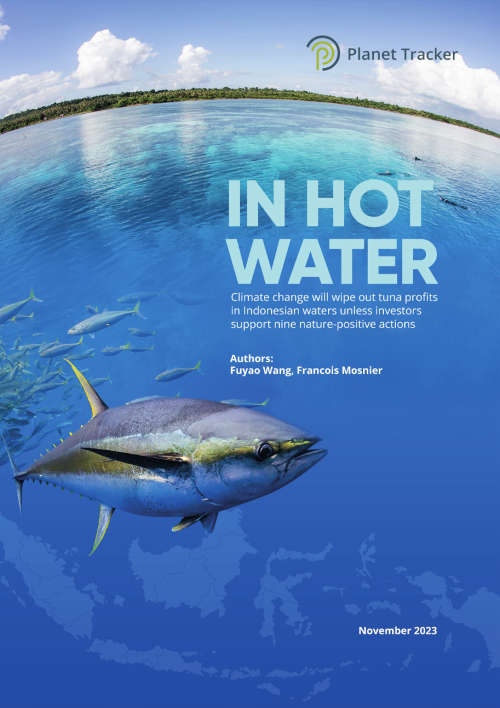
Climate change and unsustainable fishing practices will wipe out tuna profits in Indonesian waters unless investors support nine nature-positive actions
- There can be no healthy climate without a healthy ocean, and no healthy ocean without healthy tuna populations, of which Indonesia is the largest producer.
- Yet none of the 136 owners of the industrial Indonesian tuna fleet disclose how much tuna they catch, damaging fishing practices are common, and most of the tuna caught is overexploited
- Climate change will exacerbate these issues and all but wipe out the industry’s profits
- Tuna fishing companies could more than offset the toll the climate crisis will have on their profits by taking nine concrete, nature-positive actions
London, 29 November 2023: A new investigation by Planet Tracker reveals that investing in nature is a profitable solution to mitigate the financial impact of the climate crisis on companies. Focusing on one of the most nature-dependent industries – fishing –, in a country very vulnerable to climate change – Indonesia –, Planet Tracker spent a year investigating the local, world largest tuna industry, and found that its profits will all but disappear due to climate change unless companies adopt nature-positive measures now.
Healthy populations of tuna are needed for the ocean to be healthy and protect us from the worst of climate change. Top predators in the ocean food chain, tuna move nutrients throughout the water column, thus fertilising phytoplankton, a key producer of the oxygen we breathe and absorber of the carbon dioxide we release. Yet whilst tuna is ‘too big to fail’, the large-scale Indonesian industry risks failing, since the way industrial fleets operate is typically not sustainable.
One key concern is bycatch: every year, the 256 tuna vessels that Planet Tracker tracked catch millions of animals like turtles, dolphins, sharks or other fish species instead of tuna. Very often, the tuna they catch is too young, putting future revenue at risk and contributing to overfishing. Out of the 791,000 tonnes of tuna caught in Indonesian waters in 2021, the majority is overfished, subject to overfishing or harvested above recommended limits. One stock (yellowfin tuna in the Indian Ocean) is on the verge of collapse.
Climate change will make things worse: the industry will catch an estimated 25% to 31% less tuna by 2050. Depending on the industry’s and the government’s reactions, this is likely to lead to a near or total disappearance of the industry’s profits.
For investors though, knowing the magnitude of these risks is hard since not even one of the 136 owners of industrial tuna vessels in Indonesia disclose their tuna catch. Yet investors are likely to be exposed to that industry, either via large seafood companies such as Maruha Nichiro or Dongwon, or via food retailers and foodservice companies – 15% of the global tuna production comes from Indonesia.
Encouragingly, Planet Tracker found that the profitability of companies best ranked for sustainability were in line with or above the 12% average EBITDA margin in the industry. Further, implementing a series of nature-positive measures that reduce bycatch and overexploitation while improving traceability and transparency will more than offset the negative impact of climate change on the industry’s profits.
According to Francois Mosnier, Head of Oceans Programme at Planet Tracker: “The industry could dramatically reduce its negative impact on the environment while improving its long-term profits for an investment of just USD 16 million. We urge investors and lenders to support our recommendations. The industry owes it to the people of Indonesia since without fuel subsidies, it would be heavily loss-making.”
Planet Tracker recommends that tuna fishing companies:
- Reduce pressure on overexploited tuna stocks[1] by at least 20%.
- Adopt a responsible drifting FAD[2] policy
- Invest in GDST[3]-compliant tuna traceability
- Enable supply chain transparency by disclosing the volume of species caught
- Choose selective fishing methods to reduce bycatch
- Retain all fished tuna, except those unfit for human consumption
- Participate in sustainable tuna fishing initiatives,
- Replace crude palm oil by used cooking oil as a feedstock for biodiesel
- Link financial health to the environmental health of the fish populations companies rely on and take action to improve both
- ENDS –
In Hot Water: read the full report here
For more information please contact:
Francois Mosnier, Head of Oceans Programme, Planet Tracker | t: +44 | francois@planet-tracker.org
ABOUT PLANET TRACKER
Planet Tracker is an award-winning non-profit think tank focused on sustainable finance.
We engage directly with financial institutions to drive transformation of global financial activities, achieve real world change in our means of production and align investment with a resilient, just, net-zero and nature-positive economy.
Our purpose is to ensure that capital markets’ investment and lending decisions are aligned with planetary boundaries and support a just transition.
[1] Bigeye tuna and yellowfin tuna in the Indian Ocean
[2] Fish Aggregating Devices: man-made, typically floating wooden structures with hanging nets to attract fish.
[3] Global Dialogue on Seafood Traceability, an organisation that set standards for seafood traceability to enable interoperability across supply chains