Environmental Impact Analysis Reveals Advertising Agencies’ Silent Complicity
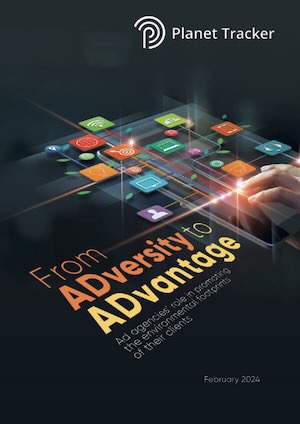
London, 23 February 2024 – A new comprehensive analysis reveals the extent to which advertising agencies are promoting clients with significant environmental impact and spotlights the apparent lack of commitment to Environmental, Social, and Governance (ESG) principles by major advertising Holding Companies: (Dentsu (4324) , Havas (HAV), IPG (IPG), Omnicom (OMC), Publicis (PUB), WPP (WPP).
The analysis by Planet Tracker uncovered several key findings that highlight the urgent need for industry-wide changes.
Despite the highly fragmented nature of the USD 822 billion advertising agency sector, campaigns for top brands are primarily handled by agencies belonging to six global Holding Companies.
While advertising agencies often tout their environmental awareness, the analysis of the six biggest advertising Holding Companies revealed continued widespread support for clients with damaging environmental footprints, particularly in the oil & gas and automotive industries.
Major Advertising Holding Companies appear to lack concrete ESG commitments related to their clients beyond vague statements in annual reports. Instead of refusing to work for environmentally harmful clients, the common approach is to claim to be “changing client attitudes from within”.
Many agencies rely on the industry’s own initiatives, such as Ad Net Zero, the advertising industry’s drive to decarbonise the production, distribution and publication of advertising, to present an environmentally-concerned face to the world, but this only applies to the ‘internal’ environmental footprint of the companies.
The report argues that what matters (and what investors should be aware of) is not just the ‘internal’ footprint created, but also the ‘external’ footprint supported, such as the widespread continued support of big oil. This ‘Scope 3’ type of assessment mirrors the extended supply chain evaluations industrial firms are required to conduct.
The analysis raises concerns about Advertising Holding companies potentially being included in ESG funds due to ‘positive’ ESG scores. There is a worry that investors might be ‘looking the wrong way’. and the hope is that additional screens and a thorough review of underlying dynamics prevent this from happening.
Clearer measurement and reporting by agencies regarding their clients’ environmental footprint scores are crucial to enable investors to make more informed decisions.
This is not just a ‘nice to have’ option – most large businesses already require their agencies to be a signatory to the United Nations-backed Race to Zero1 campaign, but two of the large Holding Companies are not members (IPG and Omnicom)2 and as yet there is no obligation to comply with the guidance on Advertised Emissions or Client Disclosure Reports, although that is currently under review.
They are very similar concepts – reporting companies, advertisers and agencies, like financial institutions – have influence over the emissions that result from their decisions and therefore a choice between more emissions or less emissions.
The concept of Advertised Emissions is an effective approach for advertising and public relations firms. Advertisers and agencies should choose not to advertise certain products in the same way that financial institutions can choose not to invest in certain industries.
The Client Disclosure Reports require PR & Advertising agencies to disclose their revenue by client industry. The purpose of these disclosures is to build transparency in ‘true’ Scope 3 for an industry whose product is mainly intangible.
There’s a real risk for agencies here as the Race to Zero campaign is currently reviewing the guidance and is likely to increase requirements. If these two initiatives move from guidance and into criteria, then most agencies will be non-compliant with Race to Zero and will risk their inclusion in pitches for new clients.
Investors, who own an average of 43% of the five listed advertising Holding Companies, are cautioned against viewing environmental footprints solely as non-financial issues.
Client losses impact the revenue line, and staff disillusioned with the environmental footprint of agencies can significantly affect employee costs which average 63% of total costs. Intangible assets, averaging 40% of Holding Companies’ asset base, are crucial and may directly influence liabilities and debt coverage. Reputational issues impacting goodwill valuations could lead to write-offs, directly impacting net income and lowering assets backing lending.
Executive compensation within advertising Holding Companies heavily prioritises financial performance over sustainability factors, with minimal linkage to client’s environmental profile and impact.
The advertising industry stands at a crossroads, and investors are urged to reassess their roles in promoting environmentally responsible practices through their investments in the sector. By making the Holding Companies and their agencies accountable, investors can drive positive change and mitigate reputational and environmental risks
Read the Report here
ENDS
For more information please contact:
Josh Hoppen, ESG Communications | t: +34 612 28 72 64 | josh@esgcommunications.com
ABOUT PLANET TRACKER
Planet Tracker is an award-winning non-profit think tank focused on sustainable finance with the purpose of ensuring that capital markets’ investment and lending decisions are aligned with planetary boundaries and support a just transition. Its mission is to create transformation of global financial activities by 2030 to bring about real world change in our means of production so that they align with a resilient, just, net-zero and nature-positive economy. Planet Tracker serves both as a watchdog on corporate behaviour, including issues such as greenwashing, and serves as an ally to support finance and business to know how to undertake transition. Having identified the companies causing the worst environmental and social damage within targeted supply chains, Planet Tracker then identifies the investors and lenders in these companies whose financing is enabling these practices to continue unchallenged.
1 Race to Zero is a global campaign to rally leadership and support from businesses, cities, regions and investors for a healthy, resilient, zero-carbon recovery that prevents future threats, creates decent jobs and unlocks inclusive, sustainable growth.