Climate misalignment persists in chemical sector
Only one of eight leading chemical companies is likely to align with the Paris Agreement ambition
London – New research from Planet Tracker finds that only one of eight leading chemical companies has a climate transition strategy aligned with the Paris Agreement ambitions, highlighting significant gaps in ambition, transparency and delivery across a sector critical to global decarbonisation. The chemical industry produces the building blocks of modern life, from plastics and fertilisers to semiconductors, and sits upstream of almost every sector’s decarbonisation effort.
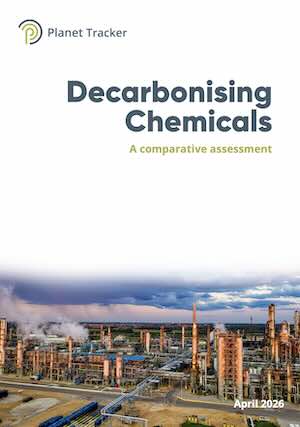
The report, Decarbonising Chemicals: A comparative assessment, provides investors and stakeholders with a cross-company analysis of transition plans across eight Climate Action 100+ companies. It assesses target ambition, performance, governance, policy engagement, risk management and capital alignment, revealing a sector that remains misaligned with the goals of the Paris Agreement. In the overall assessment, Dyno Nobel emerges as the only company likely to align with well below 2°C, while Dow and SABIC remain on 3°C pathways, characterised by modest operational targets, absent Scope 3 commitments and, in SABIC’s case, a regression in disclosure transparency. The remaining companies cluster around 2°C alignment, demonstrating partial progress but persistent structural gaps.
Planet Tracker’s analysis identifies three systemic weaknesses across the sector:
- A lack of credible Scope 3 strategies, despite these emissions representing the majority of total footprints.
- A disconnect between stated capital commitments and verifiable emissions reductions.
- Governance structures where climate incentives are not material enough to encourage transition performance.
Compared to Planet Tracker’s 2025 assessment, the latest analysis shows limited progress on the sector’s most critical challenges. Scope 3 emissions remain largely unaddressed despite being identified as the majority of emissions, while the link between capital allocation and measurable abatement continues to be unclear. Most notably, disclosure quality has deteriorated in some cases, signalling a growing gap between stated ambition and transparent, accountable transition strategies.
The findings underline a growing challenge for investors and policymakers: distinguishing between stated ambition and deliverable transition strategies. Companies that fail to address Scope 3 emissions, link capital to measurable abatement, and maintain transparent disclosure risk falling behind.
Report author Ion Visinovschi said, “Some companies are proving that a credible transition is achievable, while others are weakening ambitions, missing key emissions disclosures and targets, or relying on targets that fall short of what science requires. For investors, climate credibility in the chemical sector can no longer be assessed on commitments alone. It requires scrutiny of three fundamentals: portfolio alignment, capital allocation, and the coverage of emissions targets. Without these, net-zero ambitions risk remaining largely theoretical.”
Planet Tracker highlights three core metrics for assessing climate credibility in the chemical sector:
- Portfolio alignment with Paris goals.
- Capital allocation linked to measurable emissions reduction.
- Comprehensive coverage of emissions targets, including Scope 3.
-ENDS-
Notes to editors
The report, Decarbonising Chemicals: A comparative assessment, will be published at https://planet-tracker.org/reports/ 00.01 GMT on Tuesday 28 April.
To request a copy of the report or to arrange an interview please contact:
Sally Palmer sally.palmer@planet-tracker.org +447799472824
About Planet Tracker
Planet Tracker is an award-winning non-profit financial think tank aligning capital markets with planetary boundaries. Created with the vision of a financial system that is fully aligned with a net-zero, resilient, nature positive and just economy well before 2050, Planet Tracker generates break-through analytics that reveal both the role of capital markets in the degradation of our ecosystem and show the opportunities of transitioning to a zero-carbon, nature positive economy.