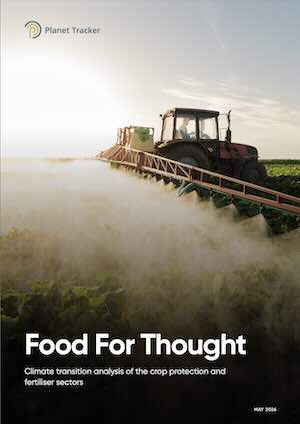
Food for Thought – Press Release
Two thirds of major fertiliser and crop protection companies fail to disclose supply-chain emissions
Planet Tracker analysis of Corteva, Mosaic, Nutrien, Syngenta Group and Yara finds no company has SBTi-validated emissions targets, while two fail to disclose Scope 3 emissions
London, [28th May 2026] – Five of the world’s largest fertiliser and crop protection companies are exposed to growing climate transition risk through weak emissions disclosure, lagging value-chain engagement and executive pay structures that often lack clear climate incentives, according to new analysis published today by financial think tank Planet Tracker.
The global food system generates roughly a third of greenhouse gas emissions. Fertiliser and pesticides companies such as Corteva, Mosaic, Nutrien, Syngenta Group and Yara play an integral role in the food system. Yet Planet Tracker identifies significant gaps in the transition plans of these five companies in its report, Food For Thought: Climate Transition Analysis of the Crop Protection and Fertiliser Sectors. None of the five companies have emissions reduction targets validated by the Science Based Targets initiative (SBTi). All five are lagging on engagement with the customers and suppliers responsible for most of their emissions footprint.
Scope 3 emissions are a material component of the emissions footprint of these companies: around 70% for Yara and Mosaic. Planet Tracker believes the proportion for Corteva, Nutrien and Syngenta is likely to be comparable.
Despite being material, Scope 3 emission disclosure is a blind spot. Syngenta Group and Nutrien do not disclose Scope 3 emissions at all. Corteva only partially discloses Scope 3. Categorisation is inconsistent in the reporting of Corteva, Mosaic and Yara, which makes meaningful comparison between peers difficult and undermines investors’ ability to assess transition risk on a like-for-like basis.
The report also highlights areas of progress across the sector, including operational emissions reductions at several companies and more developed transition planning and capital allocation strategies at Yara.
The analysis also found significant divergence in projected emissions pathways. Based on historic trends, Mosaic’s total reported emissions could rise 83% by 2030, while Yara’s could fall 24%.
Richard Wielechowski, Senior Investment Analyst at Planet Tracker said:
“Investors need consistent and transparent disclosure to assess how prepared companies are for the climate transition. Without clearer and more comparable reporting, and without credible transition planning, it will remain difficult for investors to compare companies on a like-for-like basis and assess exposure to growing transition pressures.”
Planet Tracker calls on long-term investors in the crop protection and fertiliser sectors to:
- Promote greater transparency in Scope 3 reporting, climate scenario modelling and transition costs;
- Push for companies to provide greater clarity on how they plan to reduce emissions across supplier and customer value chains;
- Prioritise companies demonstrating measurable emissions reductions and transparent climate-aligned strategies; and
- Advocate for executive compensation schemes where at least 10% of variable pay is linked to emissions reductions and climate strategy delivery.
-ENDS-
Notes to editors
The report, Food For Thought: Climate transition analysis of the crop protection and fertiliser sectors, will be published at https://planet-tracker.org/reports/ at 00.01 GMT on Thursday 28th May.
To request a copy of the report or to arrange an interview please contact:
Sally Palmer sally.palmer@planet-tracker.org +44 7799 472824
About Planet Tracker
Planet Tracker is an award-winning non-profit financial think tank aligning capital markets with planetary boundaries. Created with the vision of a financial system that is fully aligned with a net-zero, resilient, nature positive and just economy well before 2050, Planet Tracker generates break-through analytics that reveal both the role of capital markets in the degradation of our ecosystem and show the opportunities of transitioning to a zero-carbon, nature positive economy.