Banks failing to address rising methane emissions from agri-food giants
Banks are failing to act on rising methane emissions in the agriculture sector, according to new research from financial think-tank Planet Tracker.
It reviewed the policies and targets of 25 banks financing 15 of the highest-emitting meat, dairy and rice companies. Together, these companies generate an estimated 1.3 million tonnes of methane emissions per year and are among the largest emitters in a sector responsible for around 40% of global methane emissions – on a par with oil and gas. The banks provide lending and bond financing, with total exposure of USD 159 billion.
Planet Tracker found that:
- All 25 banks have targets for reducing greenhouse gas emissions from the energy sector, but only two have targets for agriculture: Barclays (UK dairy and livestock only) and Rabobank (10 agricultural sectors).
- None of the banks have policies or targets explicitly for agricultural methane. Rabobank has a commitment to “significantly reduce” methane emissions by 2050 but no specific reduction target.
- Only one bank (Deutsche Bank) has a policy of withdrawing funding from companies not willing or able to transition away from emissions-intensive activities.
Report author Ailish Layden said, “Methane is responsible for around 0.5°C of global warming and is over 80 times more potent than CO₂ over 20 years, making it the fastest lever we have to slow near-term heating. Agriculture produces around 40% of methane emissions – more than fossil fuels. Banks should use their leverage to reduce these emissions by restricting or withdrawing finance from companies that fail to act.”
Bond financing largely excluded from emissions targets
The report also found that bonds (rather than loans) account for 96% of the companies’ debt. However, most banks’ emissions targets apply only to lending, excluding the far greater climate impact of their role in arranging bond financing. JP Morgan Barclays, and Citi were the only banks to buck this trend by adopting GHG targets that cover facilitated as well as financed emissions.
Sustainability standards falling short
Planet Tracker also reviewed 12 sustainability standards and guidelines that cover the finance sector and could therefore inform banks’ policies. It found that the GHG Protocol – the most widely used standard – does not require Scope 3 emission disclosure and does not include facilitated emissions. As a result, Planet Tracker estimates that it captures less than 1% of greenhouse gas emissions from banks’ food processing clients.
Only the latest Partnership for Carbon Accounting (PCAF) standard recommends both financed and facilitated emissions, including borrowers’ Scope 3 emissions, but it remains voluntary.
Recommendations
Planet Tracker calls for:
- Robust and credible methane policies covering the food and agriculture sector.
- Targets that include both financed and facilitated emissions,
- Commitments to exiting companies unwilling or unable to transition away from methane-intensive activities.
- Mandatory disclosure of facilitated methane emissions.
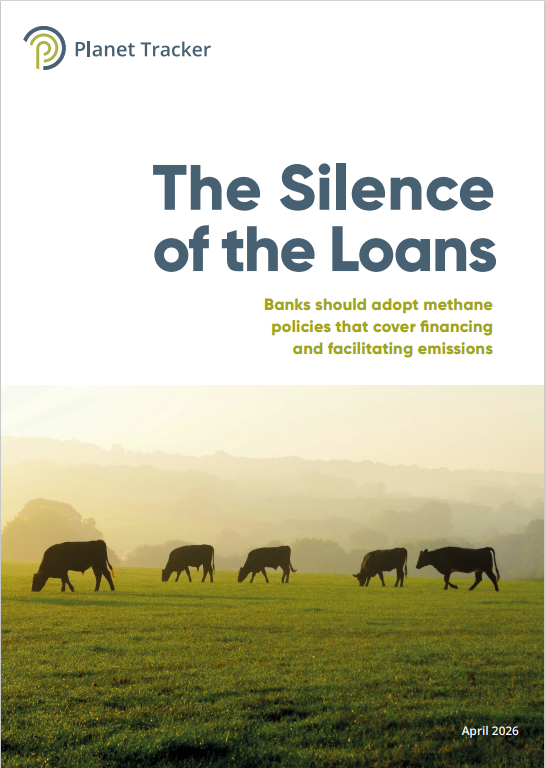
The report, The Silence of the Loans, is the third in a series examining methane emissions in the global food system and the financial institutions that enable them. The first report, Methane Matters, assessed the methane emissions disclosures of 52 of the largest methane emitters in the food processing sector. The second report, Materially Neglected, examined the methane exposure and policies of equity and bond investors in those companies.
Notes to editors
The report, The Silence of the Loans, will be published at https://planet-tracker.org/the-silence-of-the-loans/ at 00.01 GMT on Thursday 16 April.
To request a copy of the report or to arrange an interview please contact:
Conor Quinn conor.quinn@greenhouse.agency +44 7444 696 214
Greenhouse Communications TrackerGroup@greenhouse.agency
About Planet Tracker
Planet Tracker is an award-winning non-profit financial think tank aligning capital markets with planetary boundaries. Created with the vision of a financial system that is fully aligned with a net-zero, resilient, nature positive and just economy well before 2050, Planet Tracker generates break-through analytics that reveal both the role of capital markets in the degradation of our ecosystem and show the opportunities of transitioning to a zero-carbon, nature positive economy.