New research warns PFAS could become multi-billion-dollar threat to financial markets

Emissions, Plastic, Financial Risk & Reward, Shareholder Engagement, Transparency & Traceability, Equity

A group of toxic chemicals known as PFAS have moved from being a niche environmental concern to a multi-billion-dollar liability risk for investors, according to new research from financial think-tank Planet Tracker.

PFAS is now one of the most significant environmental litigation issues in history, with 15,000 active US lawsuits and a $10bn settlement by 3M in 2023.

This growing wave of PFAS-related settlements could translate into material impacts on the cash flow, balance sheets and credit profiles of exposed companies.

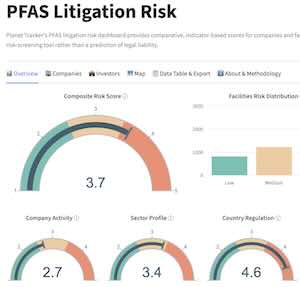
To help investors manage these risks, Planet Tracker has developed a PFAS litigation risk dashboard – an online tool to support research, valuation and stewardship efforts.

The dashboard analyses 1,082 publicly listed companies and 5,248 associated facilities for estimated PFAS litigation risk, focusing on major PFAS-using and PFAS-emitting industries in the US and Europe.

Over half of the companies (55%) and facilities (61%) are categorised as high risk, based on factors including company activity, area pollution and population concentration, as well as the strength of applicable PFAS regulation.

Planet Tracker’s analysis shows that exposure to PFAS risk is concentrated among upstream producers of specialty chemicals, fluoropolymers and firefighting foams, such as BASF SE, DuPont and Solvay SA. Roughly one third of all high-risk facilities sit within just 20 parent companies.

However, it also revealed that downstream users can still face significant liabilities through local groundwater contamination and community claims despite not manufacturing PFAS themselves. Material risks were identified in sectors as diverse as apparel, footwear, cosmetics, food packaging, waste management and water utilities.

For example, footwear company Wolverine Worldwide faced lawsuits after PFAS-containing Scotchgard used in waterproof shoe leather contaminated drinking water supplies. Settlements and costs of around $170–180 million equate to roughly 7–11% of its enterprise value of $1.6bn, demonstrating clear financial materiality.

For global asset managers, PFAS litigation risk is not just a stock specific issue but a portfolio wide one: Investment firms such as FMR, Invesco and BlackRock each hold hundreds of high-risk issuers, with combined exposure running into the hundreds of billions of dollars of equity value.

Planet Tracker urged investors to integrate PFAS liabilities into valuation, credit and risk models and to use engagement and voting to push companies to phase out PFAS. It also emphasised the need for investors to collectively integrate PFAS risk into mandates and index design, rather than treating it solely as an engagement topic.

Report author Thalia Bofiliou said, “PFAS is creating a hidden toxicity debt that is already surfacing on corporate balance sheets through mounting legal settlements and cleanup costs. Investors who downplay PFAS risk now could face abrupt valuation adjustments as more cases and regulations crystallise into hard liabilities.”

Notes to editors

The report, PFAS: From non-stick to stuck in court, will be published at https://planet-tracker.org/reports/ at 06.01 GMT on Tuesday 31st March.

To request a copy of the report or to arrange an interview please contact:

Conor Quinn conor.quinn@greenhouse.agency  +44 7444 696 214

Greenhouse Communications TrackerGroup@greenhouse.agency  

About Planet Tracker

Planet Tracker is an award-winning non-profit financial think tank aligning capital markets with planetary boundaries. Created with the vision of a financial system that is fully aligned with a net-zero, resilient, nature positive and just economy well before 2050, Planet Tracker generates break-through analytics that reveal both the role of capital markets in the degradation of our ecosystem and show the opportunities of transitioning to a zero-carbon, nature positive economy.

Privacy Overview

Our Sites use cookies to enhance your experience while using those Sites. Cookies are pieces of information that some websites transfer to the computer or device that is browsing that website and are used for record-keeping purposes at many websites.

Our Sites may place and access certain first-party cookies on your computer or device. First-party cookies are those placed directly by us and are used only by us. We use cookies to facilitate and improve your experience of our Sites and to provide and improve our services. We have carefully chosen these cookies and have taken steps to ensure that your privacy and personal data is protected and respected at all times.

All cookies used by and on our Sites are used in accordance with current data protection and privacy law.

Before cookies are placed on your computer or device, you will be shown a prompt requesting your consent to set those cookies when you access one of our Sites. By giving your consent to the placing of cookies you are enabling us to provide the best possible experience and service to you. You may, if you wish, deny consent to the placing of all cookies, but you will not be allowed access to the site.

Certain features of our Sites depend on cookies to function. These cookies are sometimes known as “strictly necessary” cookies.

Our Sites also use analytics services provided by Google. “Google analytics” refers to a set of Google tools used to collect and analyse anonymous usage information, enabling us to better understand how the relevant Site is used. This, in turn, enables us to improve our Sites and the services offered through them.

The analytics service used by our Sites uses cookies to gather the required information. Our use of these analytics does not pose any risk to your privacy or your safe use of the relevant Site, however it does enable us to continually improve that Site, making it a better and more useful experience for you.

The analytics service used by our Sites uses the following cookies:

Name of Cookie First / Third Party Provider Purpose
Google Analytics Third Google For analysing use

In addition to the controls that we provide, you can choose to enable or disable cookies in your internet browser. Most internet browsers also enable you to choose whether you wish to disable all cookies or only third-party cookies. By default, most internet browsers accept cookies, but this can be changed. For further details, please consult the help menu in your internet browser or the documentation that came with your device.

You can choose to delete cookies on your computer or device at any time, however you may lose any information that enables you to access the relevant Site more quickly and efficiently including, but not limited to, login and personalisation settings.

It is recommended that you keep your internet browser and operating system up-to-date and that you consult the help and guidance provided by the developer of your internet browser and manufacturer of your computer or device if you are unsure about adjusting your privacy settings.

Social sharing links

We also use Google Analytics to track social shares made at our website. Google automatically collect and store certain information in their server logs which includes device event information such as crashes, system activity, hardware settings, browser type, browser language, the date and time of your request and referral URL, cookies that may uniquely identify your browser or your Google Account, in accordance with their data privacy policy: https://policies.google.com/privacy

Twitter:

We use a Twitter Tweet widget at our website. As a result, our website makes requests to Twitter’s servers for you to be able to tweet our webpages using your Twitter account. These requests make your IP address visible to Twitter, who may use it in accordance with their data privacy policy: https://twitter.com/en/privacy#update

LinkedIn:

We use a Linkedin Share widget at our website to allow you to share our webpages on Linkedin. These requests may track your IP address in accordance with their data privacy policy: https://www.linkedin.com/legal/privacy-policy