Research reveals major investment risk from mismatch between corporate sustainability goals and executive pay

- More than a quarter (26%) of companies – spanning transport, chemicals and consumer goods – have no link between sustainability and executive pay.
- Planet Tracker calls for more widespread inclusion of sustainability performance in long-term pay incentives – as 55% of companies have no link between long-term compensation and sustainability.
- Planet Tracker encourages investors to ensure that management teams are incentivised to deliver on sustainable targets that are material and quantifiable.
London, May 22, 2025 – New research from Planet Tracker finds that although most companies recognise the material importance of sustainability goals, executives are not being incentivised through bonus structures to achieve them – exposing investors to risk if these targets are missed.
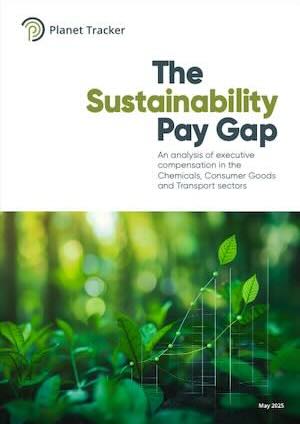
The report, The Sustainability Pay Gap: An Analysis of Executive Compensation in the Chemicals, Consumer Goods and Transport Sectors, provides investors with key metrics to scrutinise the efficacy of sustainability-linked executive pay schemes. The research analyses 31 companies listed in the CA100 and NA100, focusing on the transport, consumer goods and chemicals sectors – known to have substantial environmental impacts.
All 31 companies have a sustainability policy and explicit goals, however more than a quarter (26%) had no link at all between sustainability and executive pay. This is despite widespread reporting and acknowledgment from the cross-sector companies of how climate and other sustainability issues pose material risks to their business and present opportunities if leveraged effectively.
Planet Tracker reveals that 42% of the companies had no link between short-term compensation and sustainability. Furthermore, 55% of the companies analysed had no link between long-term compensation and sustainability.
With long-term incentives often representing 75% or more of a CEO’s total pay package, including a sustainability target in this scheme is likely to be a more meaningful incentive to take sustainability seriously.
In the consumer goods sector, Target, The Home Depot, Walmart and Woolworths Group all have SBTi targets for climate and have published sustainability-related statements from executives themselves, suggesting a commitment to sustainability. Yet, the companies disclose no link between executive pay and sustainability performance.
In contrast, Danone, Nestlé, Coca-Cola and Unilever ranked top for quantitative links between sustainability and compensation in their long-term incentive plans. However, consumer goods ranked worst of the sectors, with 36% of the analysed companies displaying no link between pay and sustainability performance at all.
Richard Wielechowski, Senior Investment Analyst, Planet Tracker:
“Corporates are telling us that environmental breakdown could be a material risk to their businesses. In response, it is positive that many are making commitments to address their environmental footprints. However, over the long term, backsliding on sustainability commitments will pose a serious reputational and business risk. To mitigate risk, investors will want to see executives held to account for meeting these commitments through their long-term incentive packages.
“Investors must question whether existing CEO pay schemes adequately incentivise progress towards sustainability goals. Failure to create deeper and more meaningful links between compensation and sustainability targets will only increase investor and corporate exposure to materiality risks.”
To ensure links to sustainability targets in executive compensation are material, investors must push for more detailed analysis and disclosures. This includes:
- Material: Performance-linked pay that is material with a percentage of compensation of at least 10% at risk based on sustainability performance.
- Verified: Independently verified targets and results (e.g. SBTi).
- Quantitative: Quantitative targets where possible.
- Annual and longer term: Targets for sustainability rewards should be annual as well as longer term.
- Independent: Sustainability delivery needs independent reward; financial targets should not trump sustainability ones.
This analysis of transport, consumer goods and chemical companies builds on the previous research finding that of 39 plastic-related companies analysed, 16 (41%) had no link between sustainability deliverables and pay. Of the 30 textile companies analysed, 17 (57%) were found to have no sustainability compensation link. Of five major advertising agencies, only one (20%) showed no link between pay and sustainability performance.
-ENDS-
Notes to editor:
For more information, please contact:
Bee O’Hara, ESG Communications | t: + 44 (0)7580 743 364| planettracker@esgcomms.com
Sally Palmer, Head of Communications, Planet Tracker | t: + 44 (0)7799472824 | sally@planet-tracker.org
About Planet Tracker
Planet Tracker is an award-winning non-profit financial think tank aligning capital markets with planetary boundaries. Created with the vision of a financial system that is fully aligned with a net-zero, resilient, nature positive and just economy well before 2050, Planet Tracker generates break-through analytics that reveal both the role of capital markets in the degradation of our ecosystem and show the opportunities of transitioning to a zero-carbon, nature positive economy.