Missing the 1.5°C Paris Alignment could cost chemical giants an extra USD 2.7 billion
- Eight companies disclosed USD 2 billion in potential carbon-related costs by 2030.
- Planet Tracker estimates actual exposure is 600% (USD 9.8 billion) higher at up to USD 11.8 billion.
- Failing to meet stated climate targets could cost these companies an additional USD 2.7 billion – almost 50% above disclosed estimates.
- None of the companies provide comprehensive quantitative estimates of physical climate risks, despite acknowledging the commercial potential of a low-carbon transition.
London, May 8, 2025 – New research from Planet Tracker finds that six out of eight major chemical companies do not have credible climate transition strategies aligned with a 1.5°C pathway by 2030. In particular, the report underlines that climate-related risks have been significantly underestimated or unquantified across the sector.
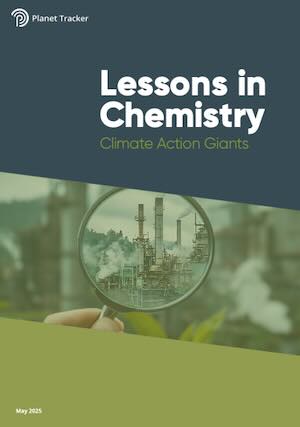
The report, Lessons in Chemistry: Climate Action Giants, offers investors a comparative analysis of these companies’ climate transition strategies up to 2030 and identifies recommendations to improve these by managing the risk and maximising the opportunities. The analysis focuses on the eight chemical companies included in the CA100+ engagement process – selected based on their size, emissions and ownership by institutional investors.
In overall the assessment, LyondellBasell and Incitec Pivot were scored as 1.5°C leaders, Air Liquide, SABIC and BASF as 2°C performers, Toray and Bayer as 2°C laggards, and Dow as a 3°C laggard – reflecting analysis of seven factors and subfactors, including emissions performance, transparency, value-chain engagement, governance integration, climate-aligned investment, and risk and opportunity management.
Seven1 of the eight companies are seen to underestimate their exposure to carbon pricing policies in their disclosures. All eight companies disclosed potential carbon-related costs close to USD 2 billion by 2030 between them, with two (Air Liquide and Incitec Pivot) not disclosing a figure. Planet Tracker estimates the actual exposure for these companies at USD 11.8 billion – a 600% (USD 9.8 billion) gap.
The cost of these seven2 companies missing their stated climate targets is estimated at an extra USD 2.7 billion, nearly 50% higher than disclosed estimates. Air Liquide could incur the highest cost at USD 1.6 billion, followed by LyondellBasell at USD 714 million. Toray only began full Scope 3 disclosure in 2024, so could not be comparatively assessed on exposure to carbon pricing risks in this analysis – but disclosed an estimated carbon cost of up to USD 1 billion by 2030.
While all eight companies reference scenario analysis, none of them provide overall quantitative estimates of physical climate risks. Disclosures remain largely qualitative or quantitatively anecdotal – reflecting a significant unquantified risk for investors.
Although all eight companies acknowledge the commercial potential of the low-carbon transition, most provide only limited detail on the scale, timing and impact of these opportunities. Notably, they lack quantified investment commitments, time-bound milestones or emissions-reduction contributions. Dow is the only company to provide a quantified goal, targeting USD 3 billion EBITDA from low-carbon products by 2030.
Planet Tracker finds that only LyondellBasell and Incitec Pivot demonstrate credible overall alignment with a 1.5°C scenario, supported by Scope 3 engagement, targeted capital deployment and integrated governance. The decarbonisation pathways of Air Liquide, BASF, Toray and SABIC are consistent with a 2°C scenario, showcasing innovation in certain areas, but lagging on Scope 3 disclosure, emissions trajectories or policy alignment. Dow lags within the group, projected to align with a 3°C outcome by 2030, exhibiting high emissions growth inconsistent with its climate goals.
Ion Visinovschi, Senior Research Analyst, Planet Tracker:
“The chemical sector’s low-carbon transition is an investment imperative. Chemical giants seem to be underestimating their exposure to the impacts of climate change from carbon pricing policies to physical risk. This could seriously jeopardise their long-term value as well as the decarbonisation of the economy.
Investors can and must play a decisive role in scaling chemicals decarbonisation by pulling on levers such as stewardship, capital allocation and strategic engagement.”
Decarbonisation as a driver of competitiveness and resilience
Transition risk for financial institutions is increasingly tangible: carbon pricing regimes, customer preferences and climate regulation will challenge business models with high emissions exposure and low adaptability. Meanwhile, firms that transparently quantify their risks, align capex with net-zero outcomes and leverage innovation to capture low-carbon opportunities are positioned to gain a competitive advantage and attract capital.
This creates both a strategic imperative and a fiduciary responsibility for investors to actively shape the transition trajectory of these companies.
Institutional investors can mitigate the sector’s climate risk by encouraging companies to:
- Integrate and disclose internal carbon pricing in investment and risk planning.
- Align disclosed carbon cost exposures with emission trends and pricing scenarios.
- Quantify physical climate risks at the asset level.
- Account for value chain exposure and test assumptions around pass-through feasibility.
- Advocate for clearer climate regulation, high-integrity carbon markets and standardised disclosure frameworks that reduce ambiguity and enable comparability.
-ENDS-
Notes to editor:
1 With the exception of Toray, which only began full Scope 3 disclosure in 2024 and thus cannot be comparatively assessed.
2 Toray only began full Scope 3 disclosure in 2024 and thus cannot be comparatively assessed.
This comparison note assessed the companies’ disclosures up until January 2025.
Read the full report here.
For more information, please contact:
Bee O’Hara, ESG Communications | t: + 44 (0)7580 743 364 | planettracker@esgcomms.com
Sally Palmer, Head of Communications, Planet Tracker | t: + 44 (0)7799472824 | sally@planet-tracker.org
About Planet Tracker
Planet Tracker is an award-winning non-profit financial think tank aligning capital markets with planetary boundaries. Created with the vision of a financial system that is fully aligned with a net-zero, resilient, nature positive, and just economy well before 2050, Planet Tracker generates break-through analytics that reveal both the role of capital markets in the degradation of our ecosystem and show the opportunities of transitioning to a zero-carbon, nature positive economy.