New report calls on Brazil to issue a Deforestation-Linked Sovereign Bond to help fund a green recovery

The Bond would boost Brazil’s sovereign health and align its fiscal objectives with investors’ sustainability ambitions
LONDON, 13 July 2021. A new report from Planet Tracker and the Grantham Research Institute assessing Brazil’s sovereign health shows that the country is on an environmentally unsustainable path to 2030 and beyond, depleting its natural capital base through deforestation, bringing systemic risks to its sovereign bonds.
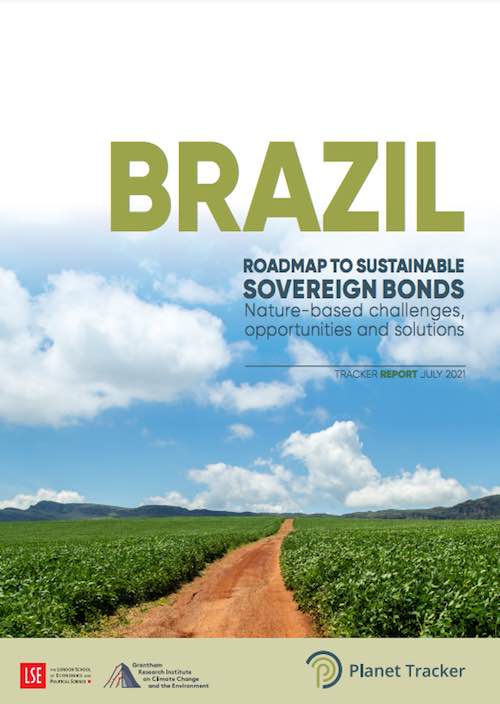
The report “Brazil: roadmap to sustainable sovereign bonds’ sets out four steps Brazil could take to change direction, including issuing an innovative Deforestation-Linked Sovereign Bond tying interest payments to its success in reducing deforestation.
“A Deforestation-Linked Sovereign Bond would be an effective way for Brazil to align its fiscal and sustainability ambitions with those of the capital markets,” said Peter Elwin, Director of Fixed Income & Head of Land Use Programme at Planet Tracker and one of the report’s authors. “Deforestation is depleting Brazil’s natural capital base, threatening its economic health, and issuing a DLSB would be a strong statement by Brazil that it was intent on following a different path.”
If structural changes are not made, the authors warn that Brazil risks being left behind by the market transition to net zero, and the policy responses of other governments trying to tackle climate change.
These market and policy pressures are expected to ratchet up in 2023 and 2025, as well as in the years leading up to the pivotal 2030 deadline for the Sustainable Development Goals.
Co-author Nick Robins, Professor in Practice – Sustainable Finance at the Grantham Institute,
commented: “This report underscores the systemic nature of the sustainability challenges facing Brazil’s sovereign bonds – but it also sets out some practical ways of moving forward, which would build on growing investor demand and positive steps within Brazil (for example, from the central bank).”
Investors holding the USD 113 billion of Brazilian sovereign bonds expiring after 2030 are particularly exposed to the impact of these seismic shifts in the capital markets which were not priced in when the bonds were issued.
Peter Elwin added: “We expect investor attention on Brazil’s macro-economic fundamentals and the extent to which its sovereign bonds fail to align with investors’ sustainability objectives to increase. Credit ratings are not providing investors with sufficient warning of the risks created by Brazil’s depletion of its natural capital.”
Four-step roadmap
The report outlines a four-step roadmap towards boosting Brazil’s sovereign health, which offers an opportunity to avoid these sustainability pressures and invest to improve its sovereign health. The four steps are:
- Strengthen government policies relating to climate and nature;
- Reform public spending to end perverse subsidies and incentivise sustainable agribusiness practices;
- Invest in a green recovery from the COVID 19 pandemic;
- Issue a Sovereign Bond linked to ending illegal deforestation, with a KPI based on its original Nationally Determined Contribution (NDC) Paris target of zero illegal deforestation in the Brazilian Amazonia by 2030.
Investor call to action
Investors holding Brazilian bonds, particularly those expiring after 2030, have a strong incentive to support the rapid adoption of such a roadmap by Brazil, both in terms of benefitting from an improvement in its sovereign health, and to avoid any selling pressure they might otherwise experience in relation to Brazilian bonds as they align their portfolios with net zero commitments.
The report recommends that investors should engage with the Brazilian government, policy makers and regulators to:
- Promote a green and just recovery from the COVID-19 pandemic, which aligns Brazil with a 1.50C (Paris aligned) climate change target and embeds a transition from nature-negative outcomes to nature-positive outcomes into this action plan;
- Push for the elimination of illegal deforestation by advocating for;
- Reversal of cuts to the Ministry of Environment (and related enforcement agencies), and pressuring for more government investment in people and technology to prevent illegal deforestation;
- Strengthening of current domestic policies, laws and multistakeholder initiatives focused on preventing illegal deforestation;
- Ratification of the Escazu Agreement – designed to strengthen environmental democracy and protection for Indigenous peoples and those protecting the environment – which Brazil signed in September 2018 but has yet to adopt.
- Promote significant reduction of legal deforestation and actions to reduce the risk of fires in or near forest areas.
- Establish a credible framework for the issuance of Deforestation-Linked Sovereign Bonds.
Wider actions applicable across portfolios
Beyond the specific recommendations relating to Brazil, the report identifies several actions investors can take to help reduce natural capital risks in their portfolios and facilitate identifying opportunities:
- Support the Taskforce for Nature-related Financial Disclosures (TNFD) initiative in driving standardisation of quality public disclosure of nature related risks (by companies and sovereign issuers);
- Engage with Credit Rating Agencies (CRAs), as well as ESG information providers, to more effectively capture nature-related risks (and opportunities) in their products and services;
- Commit to working towards deforestation free portfolios (with a focus on illegal practices as a starting point, and net zero deforestation as an end goal).
– END –
Notes for editors
ABOUT PLANET TRACKER
Planet Tracker is a non-profit financial think tank aligning capital markets with planetary boundaries. It was created primarily for the investor community to analyse the risk of market failure related to environmental limits which, other than climate change, are often not aligned with investor capital. Planet Tracker generates breakthrough analytics to redefine how financial and environmental data interact with the aim of changing the practices of financial decision makers to help avoid both environmental and financial failure.
ABOUT THE GRANTHAM INSTITUTE
The Grantham Research Institute on Climate Change and the Environment was established in 2008 at the London School of Economics and Political Science. The Institute brings together international expertise on economics, as well as finance, geography, the environment, international development and political economy to establish a world-leading centre for policy-relevant research, teaching and training in climate change and the environment. It is funded by the Grantham Foundation for the Protection of the Environment, which also funds the Grantham Institute on Climate Change and the Environment at Imperial College London. www.lse.ac.uk/grantham/
Find out more: www.planet-tracker.org
Media contact
Terri Bloore
Finn Partners
Terri.Bloore@finnpartners.com I +44 20 7539 3578