Blue bonds could finance a fish stock recovery, says Planet Tracker

Seafood, Financial Risk & Reward, Shareholder Engagement, Fixed Income

With wild-catch fishery production set to decline, favourable debt financing vehicles may be the incentive necessary to ensure long-term replenishment of global fish stocks

London, 20 August 2020. With demand projected to rise, seafood production must increase by 118% to meet healthy dietary requirements by 2050. However, wild-catch production is expected to decline, or, at best, plateau, under a business-as-usual (BAU) scenario. To ensure sufficient resources to feed the world’s growing population, a period of restraint is needed to allow ecosystems to replenish, says the latest briefing paper by financial think tank Planet Tracker.

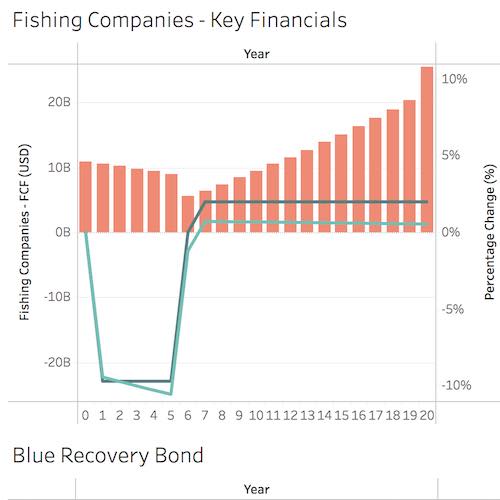
Planet Tracker constructed a model to explore the feasibility of a global recovery of fish stocks, analysing all commercial wild-catch fishing companies worldwide. The model indicates that while a BAU scenario reveals higher free cash flow in the early years, profits and free cash flow drop below the recovery scenario from year 6 and become negative in year 17.

This means that commercial fishing companies will not be able to finance themselves through funds generated by their own operations from Year 17 and will require external capital. However, while most commercial fishing companies may agree that replenishing fish stocks will ultimately lead to higher profit, they may be unable or unwilling to bear the short-term financial consequences.

In this light, Planet Tracker proposes that a blue bond may be the solution, whereby investors would subsidise the difference in free cash flow compared to a BAU scenario for five years, provided that companies demonstrate they are fishing at a reduced capacity. Once stocks begin to recover, companies may fish at a higher rate again and begin repaying investors.

Under this framework, the interests of both investors and fishing companies are both aligned and there would be a financial incentive to prevent overfishing.

While there are barriers to the successful implementation of this framework including finding the right bond issuer agreement, appropriate monitoring and regulation and potential impact on seafood processing companies and employment in the wild-catch fishery sector, holistic management policies for the blue economy have been shown to improve sustainability and profitability at regional scale. Indeed, evidence indicates that the global costs-benefits ratio – the overall monetary benefits of a project relative to its costs – for fisheries management reform is approximately 9.2:1, with the ratio higher than 200 in some countries.

Agreeing a global quota to fish poses yet another obstacle; however, on August 17th 2020, the European Commission adopted a proposal to implement a multiannual management plan for some fish stocks in the Western Mediterranean, signifying a step towards solving this problem.

Restrictions on catch, together with robust debt financing vehicles, can assist in creating a financially conservative transition scenario to sustainable oceans, which is not only more profitable than BAU in the long-term, but also supports the global goal of feeding a growing population and preventing the collapse of vital ocean ecosystems.

– END –

Notes for editors

About Planet Tracker

Planet Tracker is a non-profit financial think tank aligning capital markets with planetary boundaries. It was created to investigate the risk of market failure related to environmental limits. This investigation is primarily for the investor community where environmental limits, other than climate change, are poorly understood, even more poorly communicated and not aligned with investor capital. Planet Tracker generates breakthrough analytics to redefine how financial and environmental data interact with the aim of changing the practices of financial decision makers to help avoid both environmental failure and financial collapse.


Media contact

Ellie Hyman

Moorgate Communications, a Finn Partners company

ronak.anand@finnpartners.com

+44 20 7377 4995

Privacy Overview

Our Sites use cookies to enhance your experience while using those Sites. Cookies are pieces of information that some websites transfer to the computer or device that is browsing that website and are used for record-keeping purposes at many websites.

Our Sites may place and access certain first-party cookies on your computer or device. First-party cookies are those placed directly by us and are used only by us. We use cookies to facilitate and improve your experience of our Sites and to provide and improve our services. We have carefully chosen these cookies and have taken steps to ensure that your privacy and personal data is protected and respected at all times.

All cookies used by and on our Sites are used in accordance with current data protection and privacy law.

Before cookies are placed on your computer or device, you will be shown a prompt requesting your consent to set those cookies when you access one of our Sites. By giving your consent to the placing of cookies you are enabling us to provide the best possible experience and service to you. You may, if you wish, deny consent to the placing of all cookies, but you will not be allowed access to the site.

Certain features of our Sites depend on cookies to function. These cookies are sometimes known as “strictly necessary” cookies.

Our Sites also use analytics services provided by Google. “Google analytics” refers to a set of Google tools used to collect and analyse anonymous usage information, enabling us to better understand how the relevant Site is used. This, in turn, enables us to improve our Sites and the services offered through them.

The analytics service used by our Sites uses cookies to gather the required information. Our use of these analytics does not pose any risk to your privacy or your safe use of the relevant Site, however it does enable us to continually improve that Site, making it a better and more useful experience for you.

The analytics service used by our Sites uses the following cookies:

Name of Cookie First / Third Party Provider Purpose
Google Analytics Third Google For analysing use

In addition to the controls that we provide, you can choose to enable or disable cookies in your internet browser. Most internet browsers also enable you to choose whether you wish to disable all cookies or only third-party cookies. By default, most internet browsers accept cookies, but this can be changed. For further details, please consult the help menu in your internet browser or the documentation that came with your device.

You can choose to delete cookies on your computer or device at any time, however you may lose any information that enables you to access the relevant Site more quickly and efficiently including, but not limited to, login and personalisation settings.

It is recommended that you keep your internet browser and operating system up-to-date and that you consult the help and guidance provided by the developer of your internet browser and manufacturer of your computer or device if you are unsure about adjusting your privacy settings.

Social sharing links

We also use Google Analytics to track social shares made at our website. Google automatically collect and store certain information in their server logs which includes device event information such as crashes, system activity, hardware settings, browser type, browser language, the date and time of your request and referral URL, cookies that may uniquely identify your browser or your Google Account, in accordance with their data privacy policy: https://policies.google.com/privacy

Twitter:

We use a Twitter Tweet widget at our website. As a result, our website makes requests to Twitter’s servers for you to be able to tweet our webpages using your Twitter account. These requests make your IP address visible to Twitter, who may use it in accordance with their data privacy policy: https://twitter.com/en/privacy#update

LinkedIn:

We use a Linkedin Share widget at our website to allow you to share our webpages on Linkedin. These requests may track your IP address in accordance with their data privacy policy: https://www.linkedin.com/legal/privacy-policy